



Connecting the Creeks: Oborevwori Delivers Strategic 31-Kilometre Ohoror–Bomadi Road
By Fred Latimore Oghenesivbe Esq
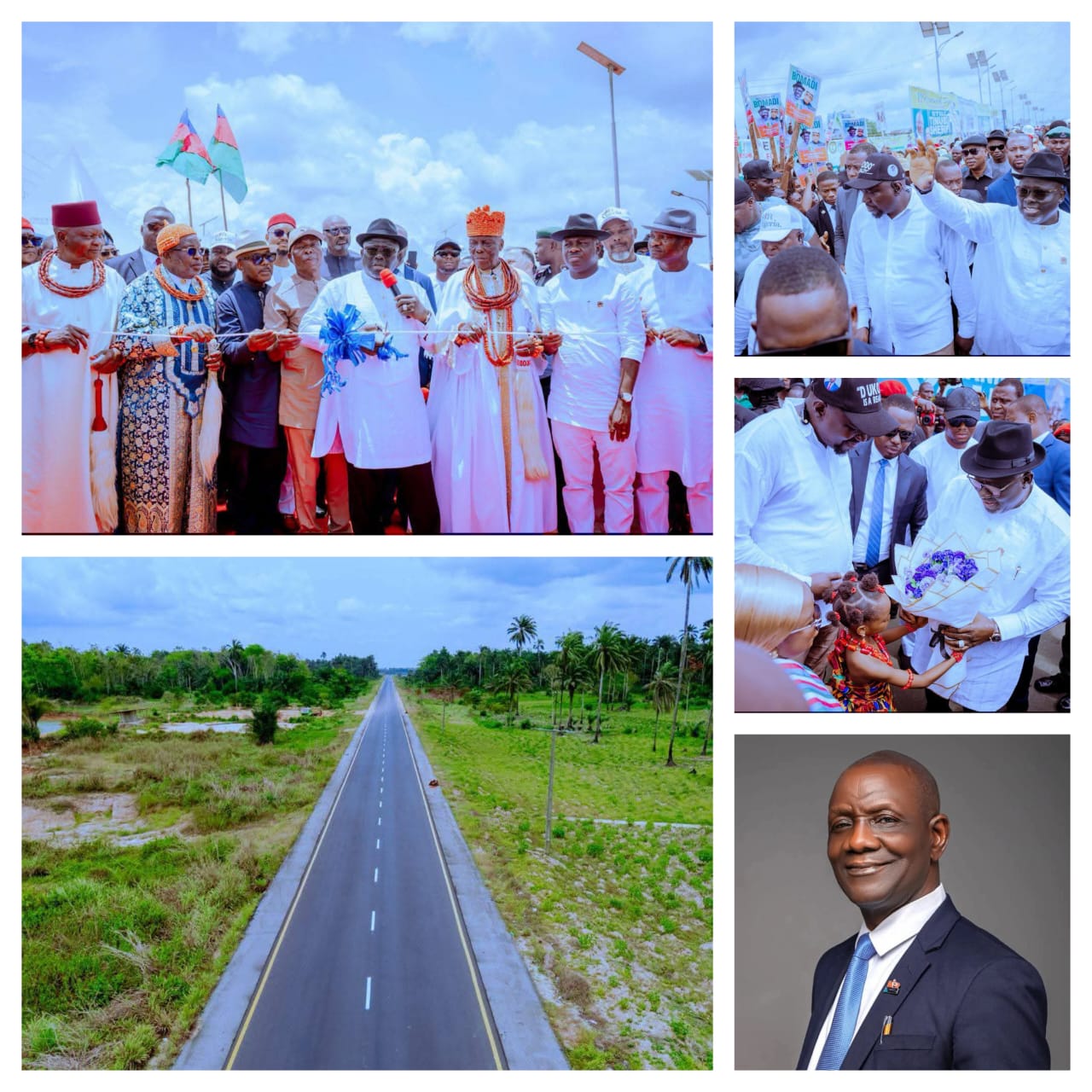
On a humid Tuesday of 13th March in Delta State’s riverine belt, jubilation rippled through communities long defined by isolation. For many residents, the inauguration of the 31-kilometre Ohoror–Bomadi Road was more than a ceremonial ribbon-cutting, it was a long awaited reconnection to opportunity, movement, and visibility.
At the centre of the moment stood Governor Sheriff Oborevwori, who used the occasion to frame the project as part of a broader mission: rewriting the development story of Delta’s riverine communities. For decades, these areas crisscrossed by creeks and defined by difficult terrain have struggled with poor infrastructure, limiting economic growth and access to essential services.
“We are resolved to rewrite the story of our riverine communities,” the governor declared, his words echoing across a crowd of residents, political leaders, and traditional rulers who had gathered to witness what many described as a historic intervention.
A Road Through the Swamp
Stretching across multiple local government areas, including Ughelli North, Ughelli South, Patani, Burutu, and Bomadi, the newly reconstructed road is not just long in distance but ambitious in design. Built to withstand the challenges of swampy terrain, the project required extensive engineering: sand filling, soil stabilization, reinforced concrete structures, embankment protection, and asphalt surfacing.
The road varies in width from 6.5 to 10.3 metres, with hard shoulders in select sections, features that signal durability and modern planning in a region where roads often succumb to the elements.
For commuters and traders, the transformation is immediate. What was once a slow, risky journey marked by potholes and waterlogged paths is now a smoother, faster corridor linking communities and markets.
Beyond its physical structure, the road represents an economic lifeline. Improved connectivity is expected to reduce travel time, lower transportation costs, and open new channels for trade. Farmers can move produce more efficiently, businesses can expand their reach, and residents can access healthcare and education with fewer obstacles.
The governor Oborevwori emphasized that infrastructure like this is central to economic growth, connecting rural producers to urban markets and encouraging investment in previously neglected areas. Local leaders echoed this sentiment.
Hon. Dagidi Andaye, Chairman of Bomadi Local Government Council, described the project as unprecedented in recent memory. According to him, the area had not seen such significant infrastructure in over 16 years, a gap that underscores the scale of neglect residents have endured.
While the Ohoror–Bomadi Road took centre stage, it is part of a wider development agenda. Governor Oborevwori highlighted ongoing and completed projects spanning roads, bridges, education, and power, all anchored on his administration’s MORE Agenda focused on fairness, justice, and equity.
He revealed that the State Executive Council recently approved projects worth over N400 billion across key sectors, including infrastructure, health, education, power, judiciary, and security. In the power sector, efforts are underway to extend transmission lines and install transformers, reconnecting communities that have been without electricity for over a decade. Security, too, is on the agenda, with plans to establish police divisions across all 25 local government areas and a Special Protection Base to enhance safety.
For residents, the impact of the road is already tangible. Community leaders such as Nicholas Mutu and James Manager joined others in praising the governor’s efforts, noting that the project has eased long-standing hardships caused by poor access and high transportation costs.
Traditional ruler, HRM Pere Luke Kalalanama and other stakeholders described the road as a symbol of inclusion, evidence that riverine communities are no longer being left behind. Their endorsements also carried a political undertone, with assurances of continued support for the governor and Bola Tinubu ahead of the 2027 elections.
As the crowd dispersed and vehicles began to ply the new road, a sense of cautious optimism lingered. For years, development in Delta’s riverine areas has been more promise than reality. Now, with a tangible project cutting through the swamp, many are hopeful that this marks a genuine turning point.
NSUK Matriculates 8,604 Students, Charges Freshers on Discipline and Excellence
The newly commissioned 31-Kilometre Ohoror-Bomadi Road stands as a powerful symbol, a stretch of asphalt binding together communities and perhaps, at last, bridging the gap between neglect and progress.
***
The Writer, Dr (Barr) Fred Latimore Oghenesivbe, is the Director General, Delta State Bureau for Orientation and Communications, Governor’s Office Asaba.