
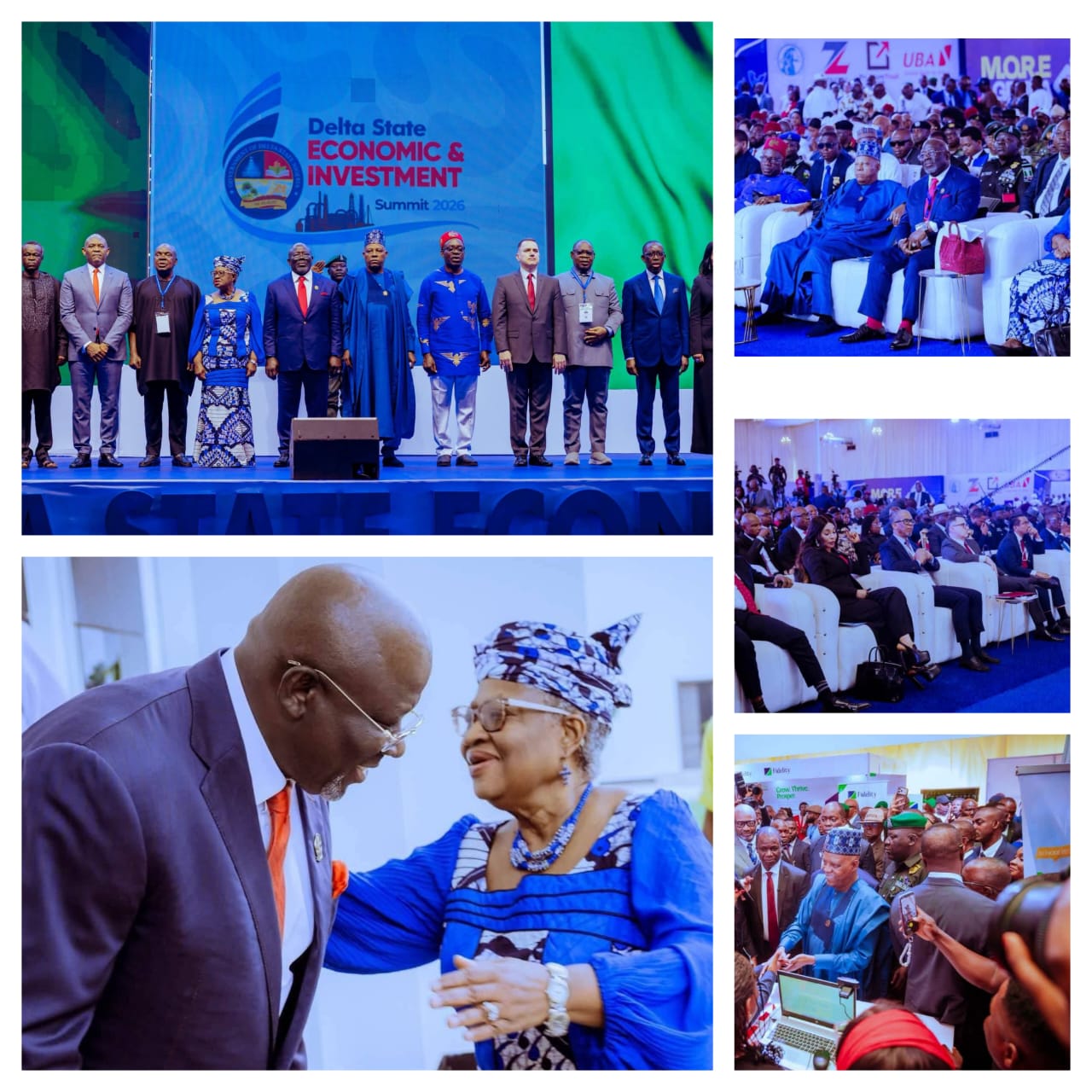
Shettima, Oborevwori, Okonjo-Iweala, Elumelu, Soludo, Avuru, Lumumba and Oyedele Set Bold Agenda for Delta’s Economic Transformatio
By Fred Latimore Oghenesivbe, Esq.
The 2026 Delta State Economic and Investment Summit in Asaba represents a significant milestone in the state’s economic repositioning strategy, bringing together policymakers, global economic voices, development experts and private-sector leaders around a shared objective: transforming Delta’s existing economic advantages into a more diversified, investment-driven and globally competitive economy.
The summit’s importance is further reinforced by the convergence of ideas from Vice President Kashim Shettima, Governor Sheriff Oborevwori, WTO Director-General, Dr. Ngozi Okonjo-Iweala, Anambra State Governor, Prof. Charles Soludo, energy expert, Austin Avuru, Pan-African scholar, Prof. Patrick Lumumba, Finance Minister, Prof. Taiwo Oyedele and one of Africa’s leading investors, Mr. Tony Elumelu. Their interventions, though delivered from different perspectives, point towards a common economic conclusion: Delta possesses the resource base, strategic location, human capital and policy foundation required to become one of Nigeria’s leading investment destinations.
Vice President Kashim Shettima provided the national economic context by describing Delta as “a first-order investment destination.” He said the economic reforms of President Bola Ahmed Tinubu’s administration have strengthened macroeconomic stability, improved Nigeria’s global credit profile and restored investor confidence.
His declaration that “the best time to invest is now before the opportunity becomes expensive” reflects the competitive nature of global capital allocation. Investors are increasingly directing funds towards jurisdictions where policy direction is clear, economic fundamentals are improving and opportunities exist for long-term value creation.
The Vice President also captured Nigeria’s broader economic transition when he stated that “we are co-travellers on the road from promise to production, from allocation to transformation, and from potential to prosperity.” For Delta, that transition means converting its natural resource endowment into productive assets, industrial capacity, employment opportunities and sustainable economic value.
That national economic outlook found practical expression in Governor Sheriff Oborevwori’s investment strategy. At the centre of the summit’s economic proposition is the governor’s unveiling of a US$100 million Viability Gap Funding (VGF) facility to de-risk strategic private-sector investments and accelerate capital inflows into critical sectors.
The initiative is not a substitute for private capital; rather, it is a strategic financial instrument designed to improve project bankability, reduce investment risk and crowd in domestic and international investors into an economy already valued at approximately ₦17 trillion.
A pragmatic economic manager and prudent allocator of public resources, Governor Oborevwori has demonstrated a clear understanding of modern investment governance: government must not only create policies but also deploy targeted instruments that convert opportunities into viable, financeable projects. His emphasis on fiscal responsibility, investment discipline and sustainable economic planning reflects a leadership approach focused on measurable outcomes and long-term prosperity.
Beyond the VGF, the administration has introduced tax incentives, streamlined investment processes through an Ease of Doing Business Council, provided waivers on selected charges and identified strategic sectors including commercial agriculture, energy, manufacturing, logistics and the blue economy for accelerated investment. These measures collectively strengthen Delta’s investment ecosystem and enhance the state’s competitiveness as a destination for productive capital.
Dr. Ngozi Okonjo-Iweala expanded the conversation from domestic investment attraction to global competitiveness. Describing herself as “a Delta State optimist,” the Director-General of the World Trade Organisation urged the state to leverage global supply-chain realignments, the African Continental Free Trade Area (AfCFTA) and Nigeria’s economic reforms to become “the country’s next industrial growth hub.”
Her recommendations were strategic: increased investment in the Delta Special Economic Zone, agro-processing, oil and gas value addition, marine logistics, blue economy infrastructure, digital connectivity and artificial intelligence. Her message was clear that Delta’s economic future must combine natural resource advantage with technology, innovation and human capital development.
Former Governor of Central Bank of Nigeria, and Governor of Anambra State, Prof. Charles Soludo reinforced the importance of macroeconomic stability and regional economic integration. Observing that Nigeria has moved “from capital flight in 2023 to a more stable and predictable exchange-rate environment in 2026,” the Anambra State Governor argued that investment promotion must become a continuous economic strategy rather than an occasional government activity.
His advocacy for stronger collaboration between Delta and Anambra reflects the emerging reality that regional economic partnerships can expand markets, strengthen value chains, reduce transaction costs and create more attractive investment corridors.
While Soludo highlighted the importance of regional cooperation, Austin Avuru brought the perspective of private capital deployment and investment execution. His intervention underscored a fundamental investment principle: capital flows towards environments where governance is predictable, infrastructure is improving and commercial opportunities are clearly defined.
For Delta, this is particularly significant given its position as a major energy-producing state. Moving from resource extraction to value addition through gas processing, petrochemicals, power generation and industrial manufacturing will be critical to maximising economic returns from its natural assets.
Prof. Patrick Lumumba challenged Africa to rethink its development financing model by encouraging greater intra-African investment. He argued that the continent possesses the resources, talent and entrepreneurial capacity required for sustainable growth.
His message aligns with Delta’s investment strategy: attracting external capital while strengthening indigenous participation in economic development. Stronger African investment flows will deepen industrial capacity, expand regional value chains and reduce excessive dependence on foreign financing.
Finance Minister Prof. Taiwo Oyedele provided the fiscal perspective, explaining how federal reforms, including subsidy removal and foreign exchange liberalisation, have increased revenues available to states and local governments for development.
His description of Delta as “a natural powerhouse of the blue economy” reinforces the state’s competitive advantage in maritime commerce, coastal infrastructure, logistics, energy and trade.
The private sector endorsement of Delta’s investment direction was equally significant. Chairman of Transcorp Power Holdings, Mr. Tony Elumelu, pledged the company’s readiness to partner with the Delta State Government to provide reliable electricity for industries and households.
Elumelu’s intervention goes beyond a corporate commitment. Reliable and affordable power remains the foundation of industrial competitiveness, manufacturing expansion, agro-processing, digital enterprise and export-oriented production. A Transcorp-Delta partnership would represent a strategic alignment between public-sector investment facilitation and private-sector capacity, with the potential to stimulate industrial clusters, reduce production costs and improve economic productivity.
Other investment signals from the summit further strengthened Delta’s economic proposition. Mosra Energy disclosed the existence of over 200 million tonnes of coal deposits within the state, while Julius Rone revealed that Delta’s ₦42 billion investment in UTM Gas has appreciated to approximately ₦200 billion. His announcement that UTM Gas will establish its corporate headquarters in Warri by 2030 further reinforces Delta’s emerging position as an integrated energy investment hub.
As the summit concludes on Wednesday, attention will shift from policy declarations to implementation, capital mobilisation and project execution. The event is expected to produce strategic Memoranda of Understanding across gas monetisation, power generation, renewable energy, the Delta Special Economic Zone, commercial agriculture, agro-processing, marine logistics, industrial parks, digital infrastructure, mining, manufacturing and skills development.
The true measure of success will not be the number of agreements signed, but the conversion of those agreements into operational projects, investment inflows, employment opportunities, expanded production capacity and measurable economic value.
If successfully implemented, the investment commitments emerging from the summit could accelerate foreign direct investment, deepen domestic capital formation, strengthen non-oil revenue generation, expand export capacity, improve energy security and integrate Delta more competitively into African and global markets under AfCFTA.
The summit’s lasting significance lies in the economic blueprint presented by its leading voices. Shettima provided national economic confidence; Oborevwori supplied the investment de-risking mechanism; Okonjo-Iweala outlined the global competitiveness strategy; Soludo advanced regional economic collaboration; Avuru reinforced private-sector confidence; Lumumba championed African capital mobilisation; Oyedele demonstrated fiscal foundations for growth; and Elumelu provided private-sector commitment to translate opportunity into enterprise.
https://www.aljazeera.com/opinions/2026/8/3/who-will-shape-post-war-iran?traffic_source=rss
The US$100 million Investment Catalyst is therefore more than a funding commitment. It is a strategic economic instrument designed to unlock new growth opportunities within Delta’s existing ₦17 trillion economy, attract productive capital and accelerate the state’s transition from resource advantage to broad-based prosperity.
With disciplined execution, transparent governance and sustained investor confidence, the 2026 Delta State Economic and Investment Summit could become the turning point that establishes Delta as Nigeria’s premier destination for productive investment, industrial expansion and sustainable economic growth.
***
Fred Latimore Oghenesivbe, Esq, is the Director-General of the Delta State Bureau for Orientation and Communications, Governor’s Office Asaba. He’s a member of the Institute of Legal and Policy Studies (ILPS).