

LP’s Oluchi Oparah urges Senate President to prioritize security as a universal right, not a privilege, in an open letter calling for systemic reforms
Oluchi Oparah, a prominent Labour Party (LP) chieftain and former national treasurer, has urged the Senate President Godswill Akpabio to prioritize making security accessible to all Nigerians amid ongoing debates on police protection policies.
Her call followed a recent national discussions on directives to withdraw police orderlies from VIPs, emphasizing equitable security for vulnerable citizens rather than elites.
Oparah criticized recent security measures at the National Assembly, where the Senate President make an appeal for enhanced security security for lawmkers, adding that such arrangements does not favour vulnerable Individuals across the country.
Oluchi Oparah in an open letter addressed to the Senate President, Godswill Akpabio, she argued that the security should not be treated as a privilege exclusive to high office holders.
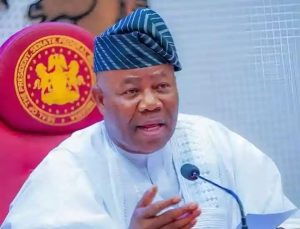
Oparah expressed concerns about equitable access and governance in Nigeria.
She contends that prioritizing officials’ security amid national threats undermines democratic equity.
The LP party chieftain calls for systemic reforms ensuring security as a universal right, not an office perk.
DEAR SENATE PRESIDENT: SECURITY SHOULD NOT BE A PRIVILEGE OF OFFICE
……Fear of the People Is a Symptom of Leadership Failure
The Senate President’s sombre appeal for enhanced police protection for lawmakers, delivered at the joint sitting of the National Assembly, may sound reasonable on the surface. However, beneath its emotional framing lies a deeply troubling implication: that security in Nigeria is gradually becoming a privilege reserved for political office holders rather than a fundamental right of all citizens.
If lawmakers were truly representing their constituencies rather than personal interests, families, and political allies they would have little reason to fear the very people who elected them. A performing lawmaker does not dread his constituents; he earns their trust, respect, and protection through service, empathy, and tangible results. Fear of the people is often a symptom of underperformance and deep disconnect.
Nigeria’s insecurity is not selective. It affects farmers in their fields, traders on the highways, students in their schools and hostels, worshippers in churches and mosques, and families in their homes. Therefore, the call for special police protection for lawmakers alone at a time when millions of Nigerians remain exposed to violence and hardship comes across as selfish and tone-deaf.
Security of lives and property is the primary responsibility of government, but it must be for everyone, not just those who make the laws. No Nigerian is more Nigerian than another. The senator, the trader, the teacher, and the farmer all deserve equal protection under the law.
Rather than appealing for personal security details, lawmakers should focus their energy on what truly matters:
• Speaking boldly against insecurity
• Making strong, people-centred laws to combat it
• Ensuring strict enforcement of those laws
• Holding the executive accountable for failures in security governance
Asking for police protection so that lawmakers will not be attacked by angry citizens is an admission that something is fundamentally broken in the relationship between the governed and those who govern them.
Public anger does not emerge in a vacuum. It is born from hunger, unemployment, inflation, fear, and years of unfulfilled promises. When citizens feel abandoned, frustration naturally finds expression.

Leadership demands courage, sacrifice, and solidarity with the suffering masses. In a nation where ordinary citizens confront insecurity daily without protection, lawmakers must not isolate themselves behind armed escorts while the people bleed.
Silence in the Chamber, Fear in the Constituency
It must also be said, without fear or favour, that many of the lawmakers who now express anxiety about their safety are those who have remained largely invisible on the floor of the Senate. These are legislators who hardly contribute to debates, rarely sponsor bills, and whose voices are seldom heard beyond ritual responses of “the ayes have it.” They function more as a supporters’ club than as representatives of the people.
Such lawmakers often choose silence over substance and caution over courage carefully avoiding actions or statements that might place them in the bad books of the powers that be. In doing so, they abandon their primary duty: to speak for the masses, challenge injustice, and give voice to public suffering.
It is therefore not surprising that lawmakers who have never moved a motion, sponsored meaningful legislation, or taken principled stands on national issues are the ones most fearful of their constituents. A true lawmaker earns the confidence of the people through visible engagement, vocal advocacy, and measurable impact not through armed escorts and protective shields.
True nation-building will not be achieved by shielding leaders from the consequences of bad governance, but by confronting insecurity head-on and restoring hope, justice, and dignity to the Nigerian people.
Nigerians are hereby advised to take note. Democracy does not end at the polling booth, it is sustained by accountability. Come 2027, citizens must mark the faces of those whose impact has not been felt and peacefully, decisively send them home with their voters’ cards.
Oluchi Oparah
Former National Treasurer
Labour Party
20/12/25