
Delta Central Decides: The Politics of Consensus and the Rise of Senator Dafinone
By Fred Latimore Oghenesivbe Esq.
History has a way of announcing itself, not in whispers, but in thunder. On April 26, 2026, at Oharisi Primary School, Ughelli, Delta Central did not merely host a political gathering; it witnessed a defining moment in its democratic evolution. What unfolded was not just a convergence of party faithfuls, but a resounding declaration of unity, strength, and collective resolve.
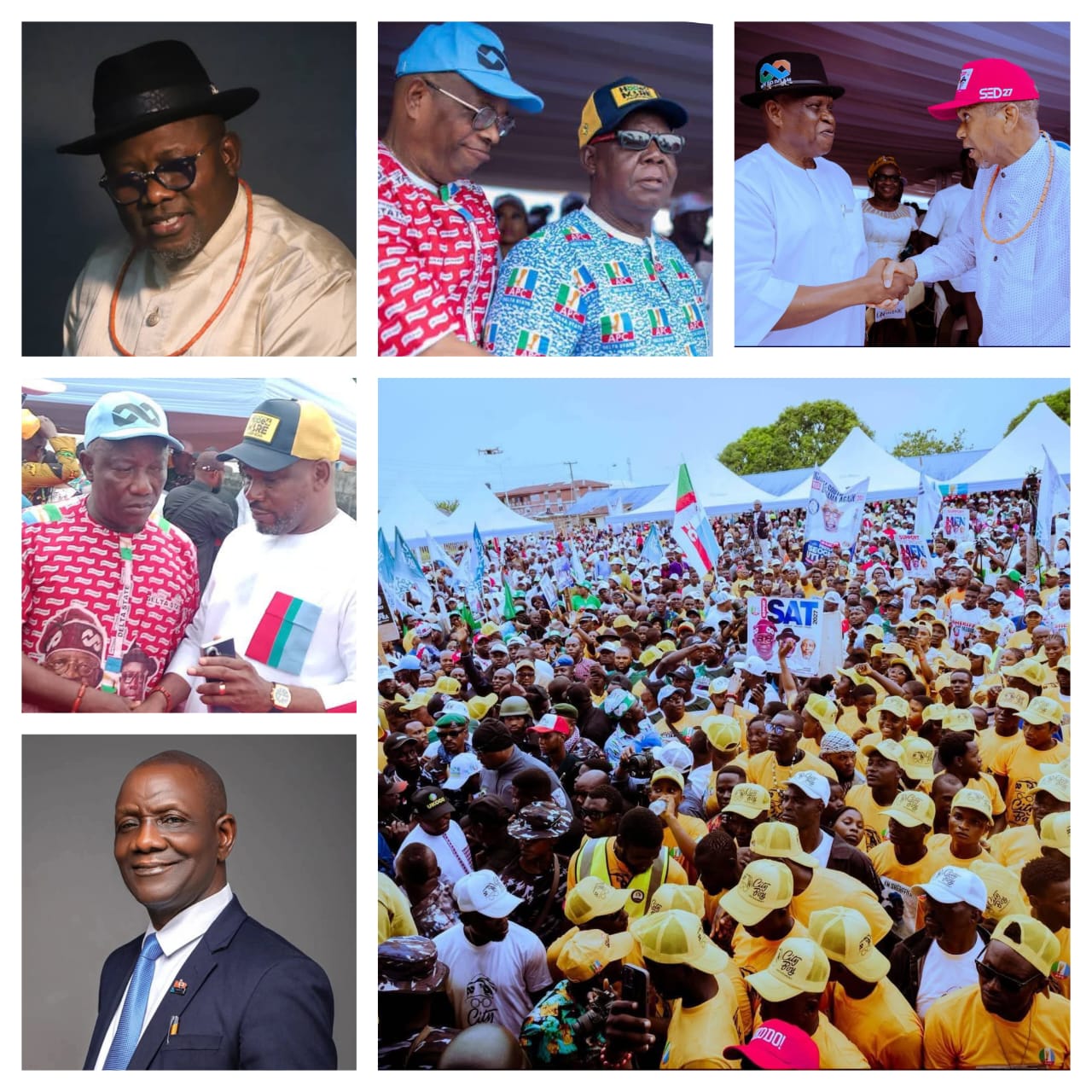
Under the blazing sun and amid electrifying chants, an estimated crowd running into the millions of political leaders, stakeholders, and party supporters in Delta Central stood shoulder to shoulder, their voices rising in unison with a singular message: Senator Ede Dafinone is the 2027 people’s choice, the All Progressives Congress (APC) consensus candidate for Delta Central Senatorial District.
This was no ordinary endorsement. It was a rare political alignment, an unmistakable signal that the often complex and layered dynamics of Delta politics had, for once, found harmony. From the corridors of power to the grassroots, the message was consistent and emphatic.
At the forefront stood the Chief Adviser to the Governor and respected leader of Ethiope Federal Constituency, Senator (Dr) Ighoyota Amori, whose voice carried the weight of experience and strategic foresight. Alongside him, the influential leader of Ughelli North/Ughelli South/Udu Federal Constituency, Chief John Oguma, lent his formidable political capital to the cause.
Completing this triad of unity was Hon. Solomon Ighrakpata, the rallying figure for Okpe/Sapele/Uvwie Federal Constituency, whose endorsement further cemented the breadth of support.
But beyond these towering figures was an even more compelling narrative: the total institutional embrace of Senator Dafinone’s candidacy. All eight local government chairmen, the full APC structure across Delta Central, members of the State House of Assembly, and councillors from every ward formed an unbroken chain of endorsement. This was not consensus by convenience; it was consensus by conviction.
Also notable were goodwill messages delivered by key political leaders, including the Speaker of the Delta State House of Assembly, Rt Hon Emomotimi Dennis Guwor, who coordinated the consensus voice vote for Senator Ede Dafinone; Member of the National Assembly representing Ughelli North/Ughelli South/Udu Federal Constituency, Rt Hon Francis Waive; Deputy Speaker of the Delta State House of Assembly, Rt Hon Arthur Akpowowo; Founding Leader of APC in Delta State, Olorogun Otega Emerhor; the State Director of Protocol (SDOP), Chief Sunday Onoriode; Chief Bernard Edewor, among others.
Observers have described the moment as unprecedented. In a political landscape often marked by fragmentation and competing ambitions, Delta Central has charted a different course, one defined by unity of purpose and clarity of vision.
Why Senator Dafinone? The answer echoed through the crowd that day, and importantly, it was backed by measurable outcomes. As he reminded the gathering, his approach to leadership has been rooted in discipline, accountability, and delivery. In just three years, his tenure has recorded tangible interventions: sustained advocacy for the revitalisation of the Sapele Seaport, the push for the extension of the Ujevwu-Itakpe railway line to Abuja, and strategic engagement on the Effurun–Sapele–Benin Road.
Beyond policy, there have been visible community impacts, including the installation of 500kVA transformers across communities, the establishment of ICT centres in key schools, a large-scale medical outreach reaching thousands, and ongoing projects such as a 50-bed hostel in FUPRE and a train stop station at Egbo Uhurie.
Equally significant is his long-standing commitment to human capital development, with over 2,000 Deltans empowered through the Dafinone Foundation, an effort that reinforces his belief that true leadership lies in creating systems that endure and opportunities that uplift.
The symbolism of the Ughelli gathering cannot be overstated. It was a demonstration of political maturity, a conscious decision by leaders and followers alike to prioritize collective progress over individual ambition. It sent a clear message to opponents and observers: Delta Central is united, focused, and ready.
As the 2027 electoral horizon gradually comes into view, the APC in Delta Central has effectively set the tone. With Senator Ede Dafinone as its consensus candidate, the party is not just preparing for an election; it is consolidating a movement anchored on continuity, competence, and coordinated development.
Looking ahead, the expectations are equally clear. The next phase of leadership in Delta Central is not merely about sustaining momentum, but about deepening economic opportunities, expanding youth empowerment, accelerating infrastructure delivery, and strengthening education and human capacity.
The consensus around Dafinone reflects not just satisfaction with the present, but confidence in a forward-looking agenda that prioritizes growth, inclusion, and long-term regional relevance in line with the Renewed Hope for MORE Agenda of President Bola Tinubu and Governor Sheriff Oborevwori.
And if the events of April 26 are anything to go by, this is a movement powered not by imposition, but by the undeniable will of the people, aligned with a leadership philosophy that emphasizes “real and measurable results” over rhetoric.
Delta Central has spoken. Loudly. Clearly. Decisively. What transpired was not just a rally; it was a strategic convergence, a political statement, clear and unmistakable. Before a sea of supporters stretching into the distance, the All Progressives Congress (APC) in Delta Central closed ranks and settled the question many thought would linger: Senator Ede Dafinone is the consensus candidate for the Delta Central Senatorial District.
This was not endorsement by routine. It was consensus forged at the highest levels of political calculation. The alignment of key leaders across the three federal constituencies; Ethiope, Ughelli/Udu, and Okpe/Sapele/Uvwie backed firmly by all eight local government chairmen, the party structure, state legislators, and councillors reflects a coalition that understands both power and timing.
In practical terms, the primary has been politically concluded before it is formally conducted. That is the weight of consensus. But every consolidation produces a moment of decision for those standing just outside its centre.
Distinguished Senator Ovie Omo-Agege is too experienced a political actor not to recognize what has unfolded. Delta Central has spoken, not in fragments, but in formation. The calculus has shifted from contest to alignment.
For Omo-Agege, alignment with Governor Oborevwori is not surrender; it is strategy sharpened by foresight. It offers continuity of influence, access to evolving structures, and a platform for sustained political relevance extending well beyond the immediate cycle, indeed, into 2031 and beyond.
Crucially, the door is not closed, far from it. Governor Oborevwori is understood to be willing, indeed prepared, to work with Senator Omo-Agege in a manner that consolidates strength rather than dissipates it. In politics, such openings are not to be ignored; they are to be seized.
To stand apart at a time of consolidation is to risk isolation; to step in is to shape outcomes. Meanwhile, within Delta Central, the equation is settled.
The path before Senator Omo-Agege is therefore less about resistance and more about relevance, an opportunity to align with a clearly defined movement that has placed collective progress above individual ambition, and to remain a consequential part of Delta Central’s unfolding political trajectory.
***
Fred Latimore Oghenesivbe Esq, is the Director General, Delta State Bureau for Orientation and Communications, Governor’s Office Asaba.