
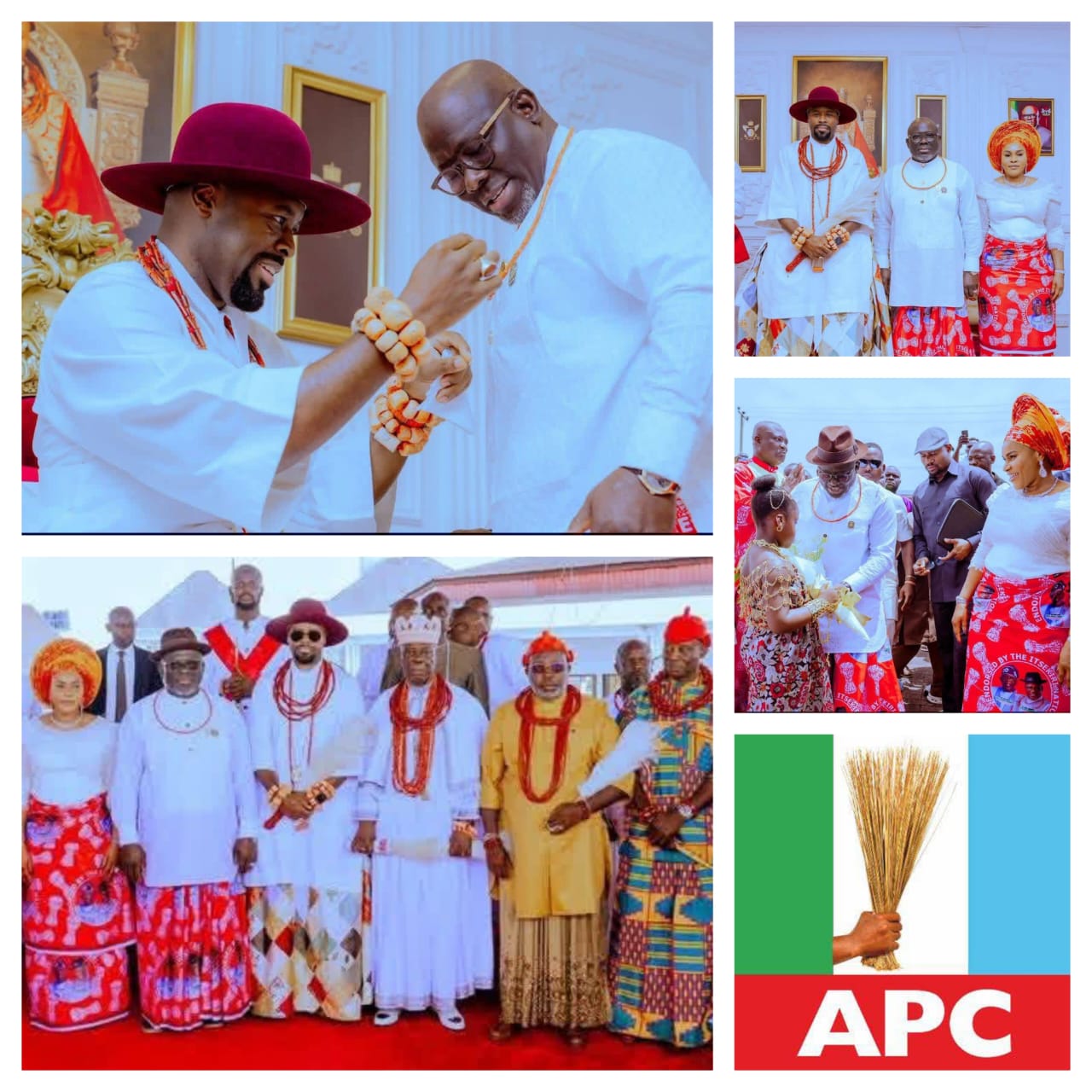
Tinubu, Oborevwori Gain 2027 Momentum as Itsekiri Nation Declares Support
By Fred Latimore Oghenesivbe Esq.
The endorsement of President Bola Ahmed Tinubu and Delta State Governor, Rt. Hon. Sheriff Oborevwori, by the Itsekiri nation has added significant political weight to the growing momentum ahead of the 2027 general elections. Coming days after a similar declaration by the Ijaw nation, the development signals an expanding regional consensus built around continuity, stability, and development-focused leadership.
The gathering at the Olu Palace Ground in Warri was not merely a political ceremony; it was a strong statement of confidence in two leaders many stakeholders believe are steadily reshaping governance at both federal and state levels.
Particularly symbolic was the conferment of the prestigious Royal Order of Iwere (ROI) on Governor Oborevwori by the Olu of Warri, Ogiame Atuwatse III. As the first non-Itsekiri recipient of the revered honour, the recognition underscored the governor’s growing acceptance across ethnic lines and his reputation for inclusive governance, humility, and bridge-building.
Beyond the symbolism, the endorsement reflects public appreciation for tangible development. Under Oborevwori’s MORE Agenda, infrastructure renewal has gained visible momentum across Delta State, especially in long-neglected riverine communities. Completed and ongoing road infrastructure projects in Itsekiri Nation worth billions of Naira, are redefining connectivity and economic prospects in Delta South.
For decades, many of these communities across Iwere land remained isolated despite their enormous economic contributions to the nation. Today, improved road access and electrification projects are opening new opportunities for commerce, tourism, fisheries, real estate growth, and small-scale industrial development.
If sustained beyond 2027, these projects could transform Delta into a stronger coastal economic hub by 2031, with expanded access to investment, transportation, healthcare, and education across previously underserved areas.
At the federal level, President Tinubu’s economic reforms are beginning to reshape national fiscal realities. Though difficult at inception, policies such as fuel subsidy removal, exchange rate harmonization, tax reforms, and infrastructure financing were designed to stabilize the economy and create a more sustainable growth path.
Increasingly, economic observers believe the long-term gains of the reforms may become more evident in the years ahead as inflation pressures ease, domestic production improves, and investor confidence strengthens. History has often shown that structural reforms require patience before their full benefits materialize.
For Delta State, stronger alignment between the federal and state governments could accelerate strategic development in oil and gas, maritime infrastructure, coastal road networks, power supply, and blue economy initiatives. Such synergy may prove critical to unlocking the vast economic potential of the Niger Delta.
What makes the Itsekiri and Ijaw endorsements politically significant is their organic nature. Unlike endorsements driven by elite negotiations, both declarations emerged openly from influential ethnic nationalities with deep historical and political relevance in the region.
The endorsements also point to a shifting political culture in Delta State, where performance, infrastructure delivery, and inclusive leadership are beginning to outweigh traditional partisan and ethnic calculations.
Governor Oborevwori’s growing cross-party acceptance, combined with Tinubu’s determination to pursue economic restructuring despite political risks, appears to be strengthening public perception of both administrations as focused on long-term governance rather than short-term populism.
Political stability and policy continuity are also critical ingredients for attracting long-term investments, and the growing support for both leaders may further boost investor confidence in Delta State and Nigeria’s economic future.
As 2027 gradually approaches, the emerging Tinubu-Oborevwori political alignment may become one of the strongest electoral forces in the South-South region. With visible infrastructure projects, expanding stakeholder support, and increasing regional consensus, both leaders appear to be consolidating broad political goodwill.
Ultimately, voters are more likely to support leadership they perceive as stable, accessible, and development-driven. Judging by the growing endorsements and rising political momentum across Delta State, Tinubu and Oborevwori may already be positioning themselves for decisive victories in 2027 and a governance legacy capable of extending well beyond 2031.
***
Fred Latimore Oghenesivbe Esq, is the Director General, Delta State Bureau for Orientation and Communications, Governor’s Office Asaba.