
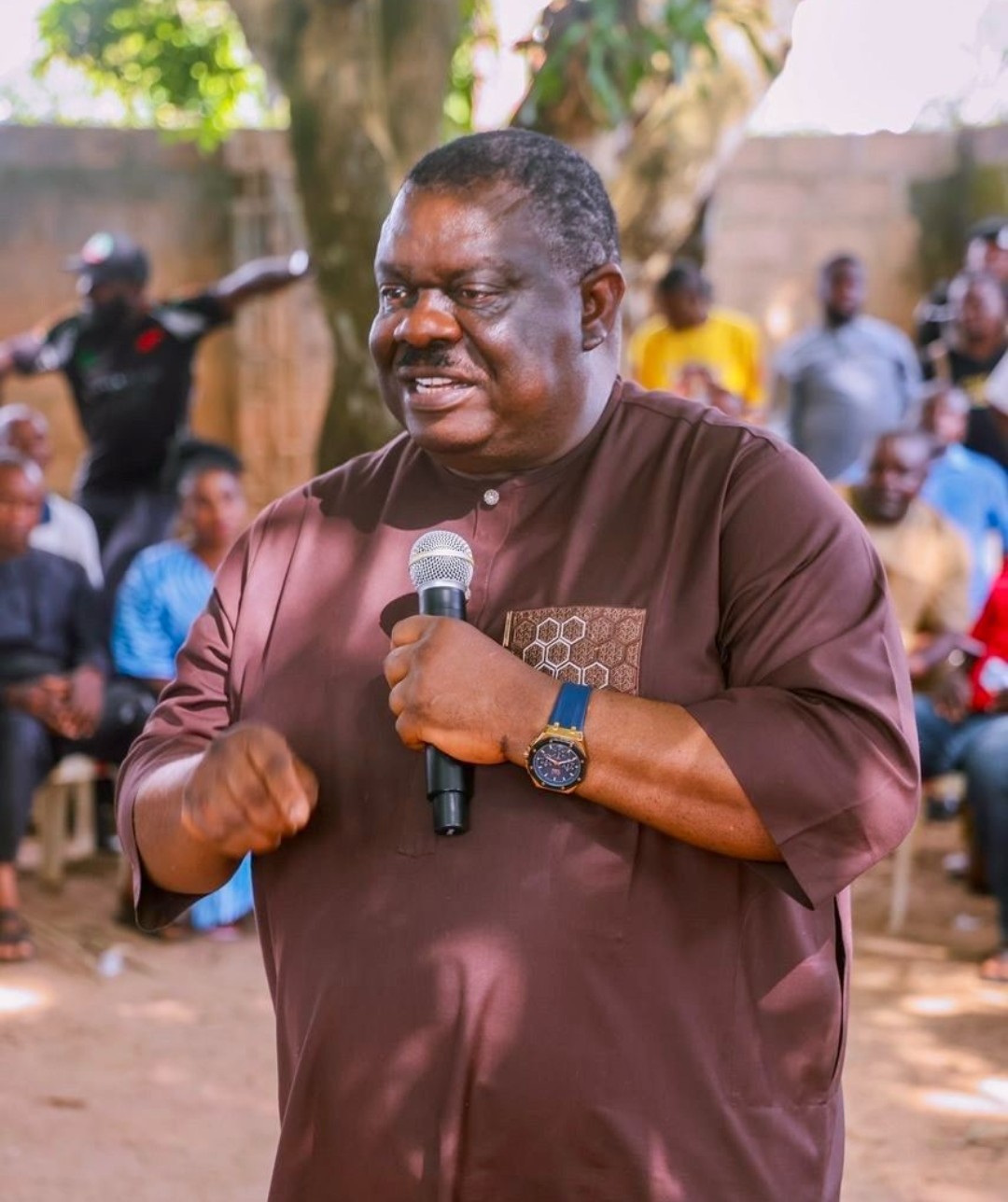
By Terver Akase, PhD
As Benue State prepares for the 2027 governorship election, one question dominates public discourse: who has the ideas, experience and courage to confront the twin crises of insecurity and economic decline that have crippled the state?
For Chief Michael Kaase Aondoakaa, SAN, the Peoples Democratic Party (PDP) governorship candidate, the answer lies not in slogans or political grandstanding, but in practical, carefully thought-out policies that address the root causes of the challenges facing Benue and Nigeria.
During a recent appearance on Arise News, the former Attorney General of the Federation and Minister of Justice laid out his views on two of the most contentious issues in the country today: ranching and State Police. What emerged from the interview was not merely a politician expressing opinions, but a statesman demonstrating a deep understanding of the security and economic realities confronting the nation.
Ranching: Turning a Security Challenge into an Economic Opportunity
For years, unprovoked attacks by terrorists on farmers have claimed thousands of lives, displaced communities and devastated agricultural production across Benue State and other parts of Nigeria. While many political leaders have treated ranching largely as a security issue, Aondoakaa approached it from both a security and economic perspective.
His position is clear: ranching is the future of livestock production, but government should not become a ranch owner. Instead, government should create the conditions that enable private investors to establish and manage ranches profitably.
This distinction is significant.
Aondoakaa argues that livestock ownership is fundamentally a private business, just like rice farming, poultry production or fish farming. Therefore, rather than using public funds to establish ranches for private cattle owners, government should focus on providing infrastructure, financing, improved cattle breeds, irrigation facilities and other support systems that make ranching commercially viable.
His proposal reflects a market-driven approach that encourages investment while avoiding the controversies often associated with government-led ranching schemes.
More importantly, it addresses one of the major fears expressed by farming communities across Benue and other states: the fear that public ranching initiatives could eventually become vehicles for land acquisition or land grabbing.
Aondoakaa believes private ranching offers a more transparent and sustainable alternative.
Under his model, livestock entrepreneurs would negotiate directly with communities and landowners through voluntary commercial arrangements. Ranch operators could acquire or lease land legally, while local farmers would benefit economically by producing specialized grass, fodder and other feed supplies needed by ranches.
This approach creates a new agricultural value chain capable of generating employment, increasing incomes and stimulating rural economies.
In essence, Aondoakaa sees ranching not merely as a security intervention but as a business ecosystem that can create wealth for both livestock owners and crop farmers.
His emphasis on cattle improvement further demonstrates his understanding of modern livestock economics. According to him, Nigeria must move beyond traditional cattle-rearing methods and invest in crossbreeding programmes that produce animals with higher milk and meat yields.
The logic is straightforward: if livestock owners can earn more from fewer animals through improved productivity, the pressure for open grazing diminishes significantly.
Coupled with affordable financing at single-digit interest rates, such reforms could transform livestock production into a highly profitable private-sector enterprise.
It is a solution that seeks to replace conflict with commerce, suspicion with partnership, and underdevelopment with productivity.
State Police: A Practical Response to Nigeria’s Security Crisis
If ranching represents Aondoakaa’s economic solution to one dimension of insecurity, his position on State Police reflects his understanding of the structural weaknesses within Nigeria’s security architecture.
For decades, Nigeria has relied almost exclusively on a centralized policing system despite growing population pressures, expanding criminal networks and increasingly complex security threats.
The result has been obvious: overstretched security personnel, slow response times and insufficient local intelligence.
Aondoakaa is among those who believe the time has come for a new approach.
His support for State Police is not rooted in political fashion or contemporary pressure. Rather, it is informed by his direct involvement in constitutional reform efforts during the administration of late President Umaru Musa Yar’Adua, when State Police was first seriously proposed as part of broader institutional reforms.
His argument is simple: the Federal Police can no longer effectively police a country as large and diverse as Nigeria on its own.
For communities in Benue State that continue to endure violent attacks, killings, kidnappings and displacement, the need for security institutions that understand local terrains, languages, cultures and intelligence networks has become increasingly urgent.
State Police, in Aondoakaa’s view, can help bridge this gap.
However, unlike many advocates who stop at supporting the concept, Aondoakaa goes further by identifying the safeguards necessary to make State Police effective and accountable.
He warns that recruitment must be protected from political interference. Allowing politicians to populate State Police formations with loyalists, thugs or political enforcers would undermine public confidence and defeat the purpose of the reform.
His insistence on professionalism demonstrates an understanding that effective security institutions depend not merely on structures but on the quality and integrity of personnel.
Similarly, he advocates a regulated framework for arms procurement, arguing that the acquisition of weapons should not become a free-for-all among states. Instead, a coordinated federal oversight mechanism should ensure standardization, accountability and national security coherence.
This reflects a balanced approach, an approach that supports decentralization without sacrificing national security interests.
His call for stronger judicial oversight further highlights a commitment to the rule of law. By ensuring that magistrates and judicial officers retain sufficient independence, State Police operations can remain subject to legal scrutiny and constitutional safeguards.
Taken together, these recommendations reveal a leader thinking beyond headlines and considering the practical details required to make reforms succeed.
Perhaps the most striking aspect of Aondoakaa’s positions is that they are rooted in problem-solving rather than political rhetoric.
On ranching, he proposes a model that protects communities, encourages investment, expands agricultural productivity and reduces conflict.
On State Police, he advocates a security structure capable of improving protection for citizens while incorporating safeguards against abuse.
Both positions reflect a broader philosophy of governance: government should create opportunities, strengthen institutions and empower citizens rather than dominate economic activity or centralize every solution.
Chief Michael Kaase Aondoakaa’s interventions on ranching and State Police suggest a leader who understands not only the nature of the problems but also the practical pathways towards solving them.
For many Benue people searching for answers to the challenges confronting their communities, that may be the most important qualification of all.