
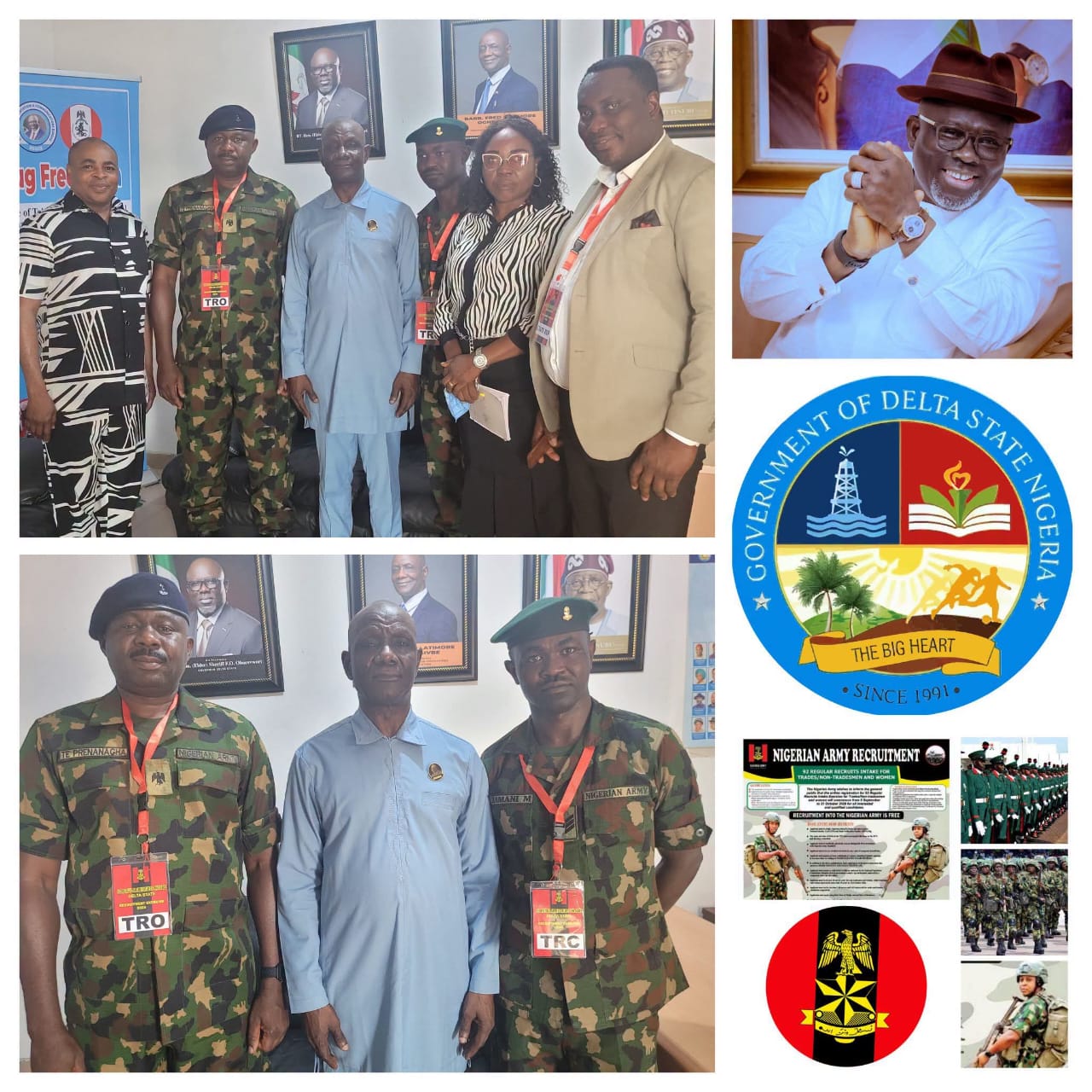
801 Delta Indigenes Shortlisted for Nigerian Army’s 92 Regular Recruits Intake
The Delta State Government has announced plans to extend its youth enlistment awareness campaign to secondary schools across the three senatorial districts as part of efforts to increase the number of indigenes recruited into the Nigerian Army, Nigeria Police Force and other military and paramilitary institutions.
The Director-General of the Delta State Bureau for Orientation and Communications, Dr Wilfred Latimore Oghenesivbe, Esq., disclosed this on Monday while receiving the Nigerian Army Temporary Recruitment Officer (TRO) for Delta State, Major T.E. Prenanagha, who led a delegation on a courtesy visit ahead of the 92 Regular Recruits Intake (92 RRI) screening exercise.
Oghenesivbe explained that the State Awareness Creation Committee on Youth Enlistment into Military and Paramilitary Services would intensify grassroots mobilisation and public enlightenment, with particular attention to secondary school students approaching the eligible recruitment age.
He said the campaign would target students preparing for the Senior School Certificate Examination (SSCE) and West African Senior School Certificate Examination (WASSCE), as well as graduates, artisans, tradesmen and holders of City and Guilds qualifications and other vocational certificates.
According to him, eligible applicants, particularly those not older than 26 years, would be reached through strategic sensitisation programmes designed to educate them about recruitment opportunities and requirements.
The Bureau DG disclosed that the state government was working towards achieving its target of 1,000 recruits per recruitment exercise, noting that 801 Delta candidates had already been shortlisted for the 92 Regular Recruits Intake screening.
He expressed optimism that at least 750 of the shortlisted candidates would successfully scale the screening process and proceed to the Nigerian Army Training Depot.
Oghenesivbe commended Governor Sheriff Oborevwori for prioritising youth empowerment and employment through legitimate opportunities in the Nigerian Army, Police and other military and paramilitary institutions.
He assured the Army recruitment delegation of the state government’s continued partnership with security agencies, traditional institutions, educational authorities and community stakeholders to ensure that qualified Delta youths take advantage of available opportunities.
Earlier, Major Prenanagha explained that he was in Delta State with a team from Army Headquarters, Abuja, following directives from his superiors to conduct the state screening exercise for the 92 Regular Recruits Intake.
He disclosed that the screening exercise would take place simultaneously across the country from November 17 to December 1, 2026.
The Army officer called for stronger collaboration with the State Awareness Creation Committee, particularly through engagements with local government authorities, secondary schools and traditional institutions.
He noted that direct interactions between military personnel, prospective recruits, students and community leaders would improve awareness about military careers, clarify recruitment procedures and encourage more eligible applicants to participate.
Major Prenanagha also highlighted the career opportunities available in the Nigerian Army, including opportunities for further education and professional development sponsored by the institution, alongside other service-related benefits.
Army Releases Mandatory Screening Requirements
The Nigerian Army has advised shortlisted candidates to report for screening with all required documents to avoid disqualification.
The mandatory documents include:
- Printed recruitment photo cards obtained from the official recruitment portal.
- Signed applicant declaration forms.
- Parent or guardian consent forms.
- Local Government Area certification endorsed by the chairman or secretary.
- Police certification signed by the Divisional Police Officer (DPO).
- Duly completed guarantor forms.
- Original educational certificates, from primary to secondary school.
- Relevant trade certificates for special-skilled applicants.
- National Identification Number (NIN) and Bank Verification Number (BVN) slips.
- Birth certificates and certificates of state of origin.
Special-skilled applicants are also required to present BVN slips duly signed and stamped by their respective banks.
Candidates are expected to appear at the screening venue with plain white T-shirts, white shorts and white canvas shoes.
The Army further warned that mobile phones, smartwatches, cameras and other electronic or recording devices would not be allowed at the screening venue.
Other prohibited practices include tattoos, body inscriptions and multiple ear piercings for female candidates, although traditional tribal marks are permitted.
Candidates were also cautioned against cultism, membership of secret societies and the presentation of forged or falsified credentials, warning that anyone found violating the guidelines would risk disqualification.
Recruitment Exercise Is Free, Army Warns Against Fraud
The Army emphasised that the 92 Regular Recruits Intake exercise is completely free, warning prospective applicants against paying money, offering gifts or providing gratification to anyone in an attempt to influence the recruitment process.
It also clarified that there would be no pre-selection Computer-Based Test (CBT) or special recruitment centre, as shortlisted candidates are expected to undergo screening in their respective states of origin.
The Delta State Government reiterated its commitment to creating more legitimate employment opportunities for young people through sustained public enlightenment, grassroots mobilisation and strategic collaboration with military and paramilitary institutions.
The planned extension of the awareness campaign to secondary schools is expected to deepen early sensitisation, broaden participation and strengthen Delta State’s representation in the nation’s security institutions.