
By Abraham Mande
Leadership is ultimately measured by the clarity of its vision, the courage to articulate difficult choices and the poise to translate commitments into practical results and for a State like Benue, grappling with insecurity, rural underdevelopment, unemployment and strained social relations, the question of what leadership should deliver has become increasingly important.
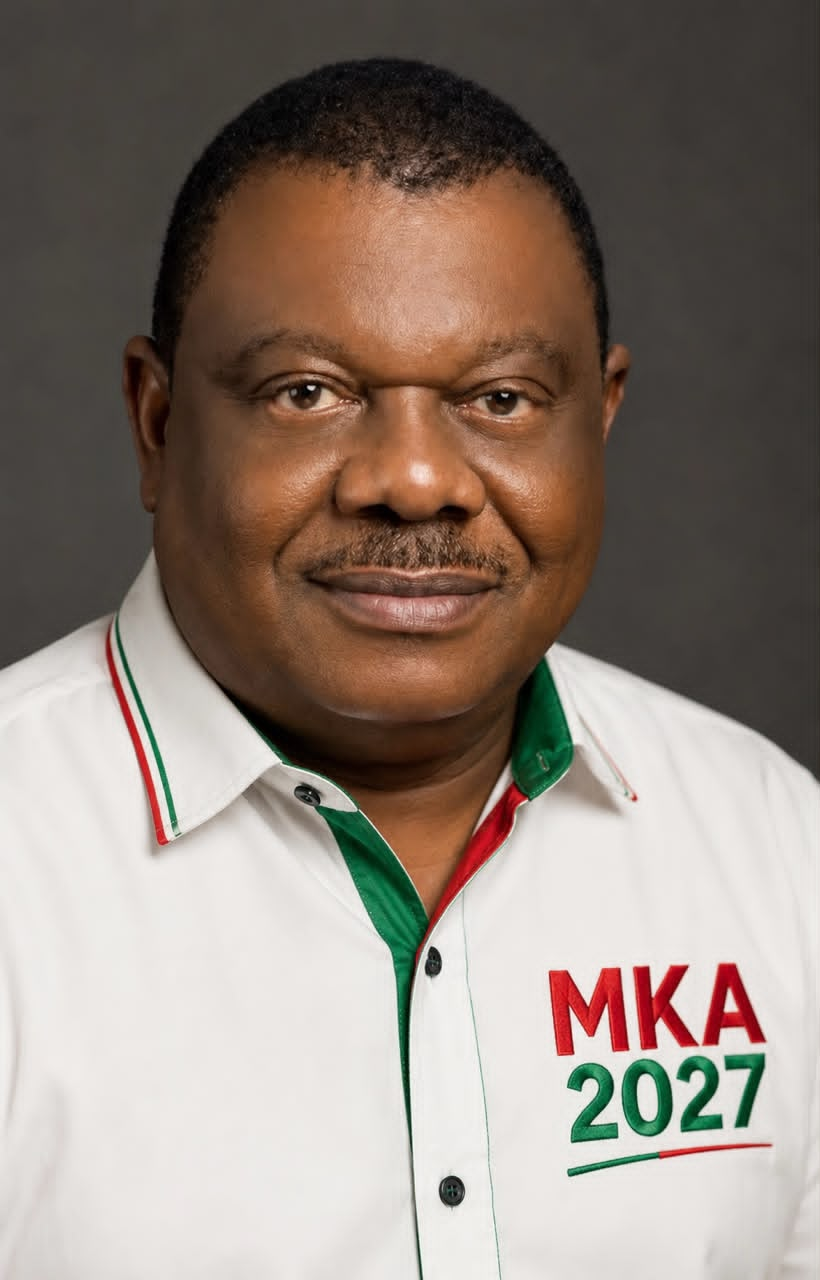
It was against this background that Chief Michael Kaase Aondoakaa, SAN, former Attorney General of the Federation and Peoples Democratic Party (PDP) Governorship Candidate for the 2027 elections in Benue State at the inauguration of his campaign team last Monday in Makurdi, used the occasion to share part of his vision.
I followed the event keenly and I noticed that beyond the political significance of his emergence as the PDP flag bearer, Aondoakaa used the occasion to outline what he considers the fundamental responsibilities of government and the direction he intends to pursue if elected Governor in 2027.
Aondoakaa’s off the cuff address captured salient points, but I will isolate a few here. His first message centred on responsibility and collective ownership of the political process.
Expressing gratitude to the PDP leadership and members for giving him the opportunity to fly the party’s flag, he described his candidacy as a collective responsibility rather than a personal political achievement. This emphasis provides an important entry point into his leadership proposition: a government that recognises the state’s diversity and accommodates different interests in its development.
For Aondoakaa, security is not merely an item on the development agenda; it is a fundamental condition for economic recovery and social stability. He pledged to protect lives and property, confront criminality and promote harmony among all residents of Benue.
Central to this commitment is his position on the Benue State Open Grazing Prohibition and Ranches Establishment Law, enacted under former Governor Samuel Ortom. Defending the legislation, Aondoakaa argued that it was designed to protect communities, regulate livestock production and prevent conflicts, not target any particular group. “This law was enacted to protect lives and property, not to persecute anybody,” he declared.
He promised to enforce the law while ensuring that farmers could access their farmlands and return home safely, while herders would be free to establish ranches in accordance with its provisions. “The law was meant to protect farmers and herders. We will stand to enforce that law. We will do everything to root out all forms of criminality,” the Governorship Candidate emphasised.
Aondoakaa made another striking declaration: “Any aggression on one Local Government Area would be seen as aggression on all the 23 Local Government Areas. We will defend and protect one another.” This reflects his approach to security as a shared responsibility requiring cooperation across geographical and administrative boundaries.
His position places the enforcement of existing legislation, protection of agricultural livelihoods and peaceful management of competing interests at the centre of his proposed security framework. For Benue, whose economy depends substantially on agriculture, the link between security, farming and food production is particularly significant.
Another defining feature of Aondoakaa’s vision is his emphasis on fairness in political appointments and the distribution of development opportunities. He criticised what he described as an imbalance in appointments under the present administration, arguing that some sections of the state had been marginalised.
He pledged to establish a government where ethnic, geographical and political differences would not constitute barriers to participation in public service. The underlying message is that the government should represent the entire state, not just a section of it.
Aondoakaa also highlighted the relationship between political leadership and democratic institutions, arguing that a Governor should focus on governance rather than struggle for control of the political party that produced him. He stressed that, “It is not the business of the Governor to struggle for control of the party. The Governor should implement the programmes of the party. We will not fight the party but implement its manifesto.”
Perhaps one of the most significant aspects of Aondoakaa’s speech was his emphasis on rural development. He faulted the concentration of development in the state capital at the expense of rural communities, arguing that progress should be measured by improvements in people’s living conditions across the 23 Local Government Areas, not activities in Makurdi alone.
His priorities include opening rural roads, strengthening community security and improving access to essential services. He also pledged to strengthen Local Government autonomy, arguing that grassroots administrations should have the capacity to address the needs of their communities.
Aondoakaa’s vision also recognises the importance of social investment, particularly women’s economic participation and healthcare delivery. He promised to organise women into cooperative societies and support them with interest-free loans to strengthen their economic activities. The proposal is built around collective enterprise, access to finance and improved opportunities for women to participate in the local economy.
“For the women, we will organise them into cooperatives and support them with interest-free loans. We will open comprehensive health centres to improve healthcare delivery to the people. Our government will be different,” he declared. These commitments place economic inclusion and accessible healthcare among his broader development priorities.
Aondoakaa’s address at the inauguration of his campaign team provided an opportunity to understand the philosophy underpinning his governorship ambition. Listening to him, I was persuaded that at the heart of his Benue First message is a commitment to inclusive governance, security for every community and people-centred development that reaches rural populations.
For a State like Benue seeking renewed confidence in its institutions and a more balanced development approach, these are issues that deserve serious public scrutiny and engagement. I am convinced that the clarity of his vision gives Aondoakaa a defined direction for translating these commitments into practical governance.
The legal icon conveyed one unmistakable message: Benue must come first, and the interests of its people must remain the overriding consideration in the exercise of leadership and governance.