
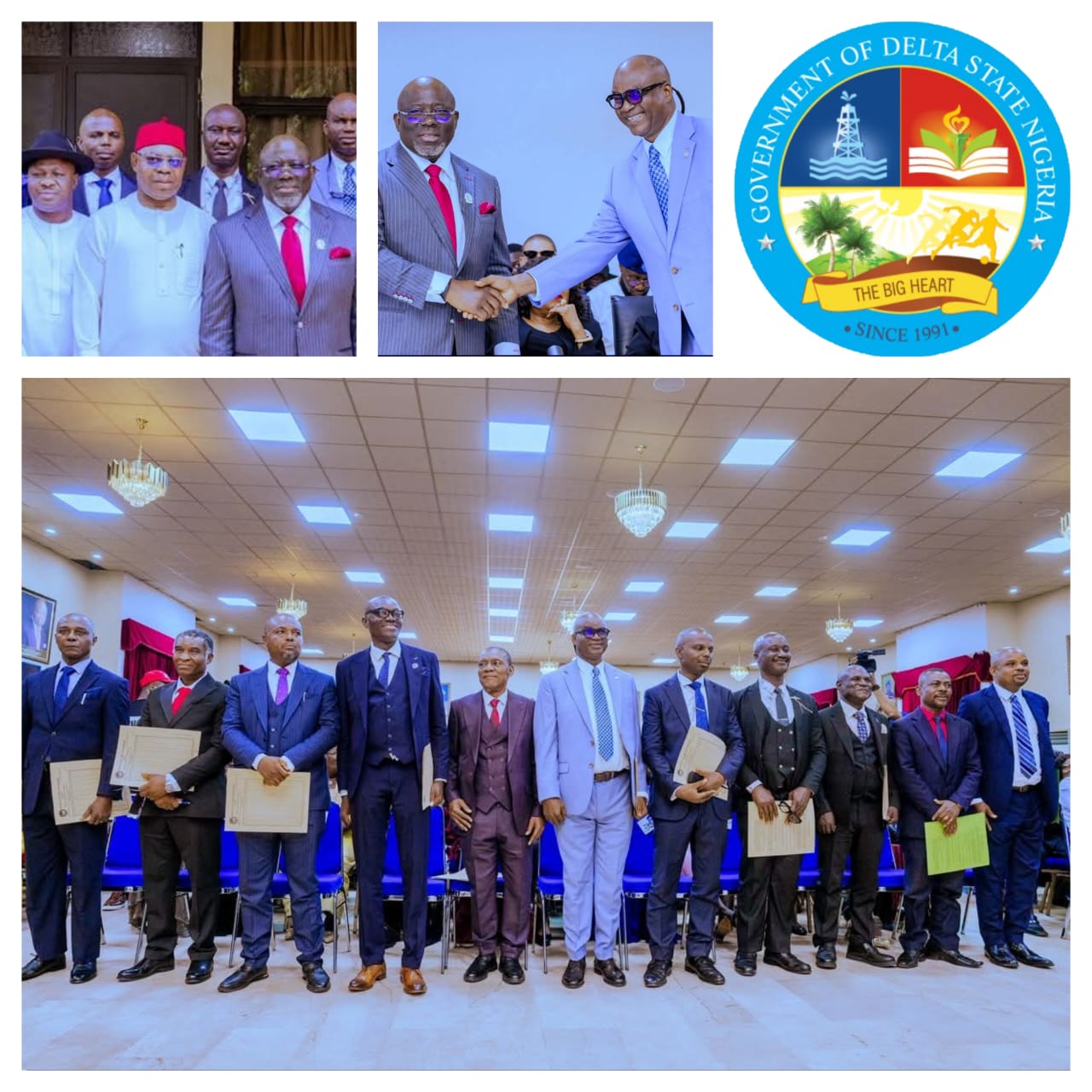
Oborevwori Aligns Appointments With Constitution, Deepens Delta Unity
By Fred Latimore Oghenesivbe Esq.
By all indications, Delta State Governor, Rt. Hon. Sheriff Oborevwori, is steadily redefining governance through a deliberate policy of inclusiveness, constitutional balance, and equitable representation across the state.
The swearing-in of 11 Permanent Secretaries on Wednesday may appear, on the surface, as a routine administrative exercise within the state civil service. However, beyond the ceremonial significance lies a deeper constitutional, political, and governance statement, one that reflects both the spirit and intent of Section 208(4) of the 1999 Constitution of the Federal Republic of Nigeria (as amended).
The constitutional provision is explicit. It states that: “In exercising his powers of appointment under this section, the Governor shall have regard to the diversity of the people within the state and the need to promote national unity.”
This section was deliberately inserted into the Constitution to discourage sectional domination, political exclusion, and concentration of public offices in the hands of a few privileged interests. It seeks to promote fairness, inclusiveness, and a sense of belonging among the diverse peoples within a state.
In practical governance terms, Section 208(4) requires a governor to ensure that appointments into strategic offices reflect the geographical, ethnic, and political diversity of the state. Governor Oborevwori’s latest appointments fit squarely within that constitutional framework.
Speaking during the swearing-in ceremony at the Unity Hall, Government House, Asaba, the governor disclosed that every local government area in Delta State, now has representation at the level of Permanent Secretary in the state civil service. More significantly, with the earlier appointment of commissioners across the state, the administration has now completed what many political observers describe as a full cycle of equitable spread and representation.
Today, all local government areas in Delta State have commissioners in the State Executive Council and Permanent Secretaries in the state civil service, a development that strongly reflects constitutional compliance and deliberate inclusive governance.
This is politically significant in a state as ethnically and politically diverse as Delta. The State is home to several ethnic nationalities spread across the three senatorial districts of Delta North, Delta Central, and Delta South. In such a plural environment, appointments into public offices are often scrutinised through the lenses of equity, fairness, and representation.
Historically, feelings of exclusion or imbalance in appointments have contributed to political tension and mistrust in many states across Nigeria. It is against this backdrop that Governor Oborevwori’s spread of appointments carries important political implications.
First, the approach strengthens unity in diversity. By ensuring that all local government areas and senatorial districts are represented in both the executive council and the top echelon of the civil service, the administration sends a strong signal that governance in Delta belongs to everyone, not a select few.
Second, the spread of appointments helps reduce political alienation and ethnic suspicion. Communities naturally feel more connected to government when they see competent individuals from their areas occupying strategic positions of authority and responsibility.
Third, the governor’s strategy deepens political stability. Inclusive governance has always been one of the stabilising pillars of Delta politics. Oborevwori appears to understand that sustainable peace and political cooperation can only thrive when all sections of the state feel carried along in government.
Fourth, the appointments also provide political consolidation for the administration ahead of future political engagements. In Nigerian politics, appointments are not merely administrative tools; they are instruments of political inclusion, coalition-building, and confidence management. A broad spread of appointments helps strengthen grassroots acceptance and political ownership of government policies across the state.
Importantly, the governor appears to have avoided sacrificing merit on the altar of political balancing. According to him, the appointments were based on merit, seniority, professionalism, competence, integrity, and proven service records.
That distinction matters. Inclusive governance without competence weakens institutions, while competence without inclusion breeds resentment. The challenge of leadership is often finding a balance between the two. In this instance, the Oborevwori administration appears to be making an effort to achieve both.
The governor’s remarks to the newly sworn-in Permanent Secretaries further reinforced his administration’s expectations of accountability and service delivery. He reminded them that their elevation was not a ceremonial reward but a call to greater sacrifice and responsibility.I
“The reward for hard work is more work,” the governor stated, while urging them to exhibit discipline, integrity, professionalism, and dedication in the discharge of their duties.
He also warned that Permanent Secretaries, as accounting officers of their ministries, would be held accountable for lapses in service delivery and administrative inefficiency.
In another significant policy direction, Governor Oborevwori announced that any officer seeking appointment as Head of Service must spend a minimum of six months in the Office of the Head of Service as a Permanent Secretary. According to him, the policy is aimed at deepening administrative experience and strengthening understanding of public service procedures and human resource management.
The newly sworn-in Permanent Secretaries are; Dr. Yinkore Paul, Dr. Okwunze Chukwuemeka, Amadubogha Peters, Nkenchor Onyeisi, Akambe Henry, Engr. Aghagba Solomon, Ogbugo Victor Chike, Ighoyota Rocky, Itawansa Augustine, Onobraekpeyan Edwin, and Nkemachor Lucky.
Ultimately, governance is often judged not merely by rhetoric but by actions that inspire confidence among the people. In a politically sensitive and diverse state like Delta, balanced representation remains critical to peace, stability, and public trust.
Governor Oborevwori’s spread of appointments across the three senatorial districts and the 25 local government areas may therefore be seen not just as political calculation, but as a conscious effort to align governance with constitutional principles, inclusive leadership, and the enduring ideal of unity in diversity.
***
Fred Latimore Oghenesivbe Esq., is the Director General, Delta State Bureau for Orientation and Communications, Governor’s Office Asaba.