
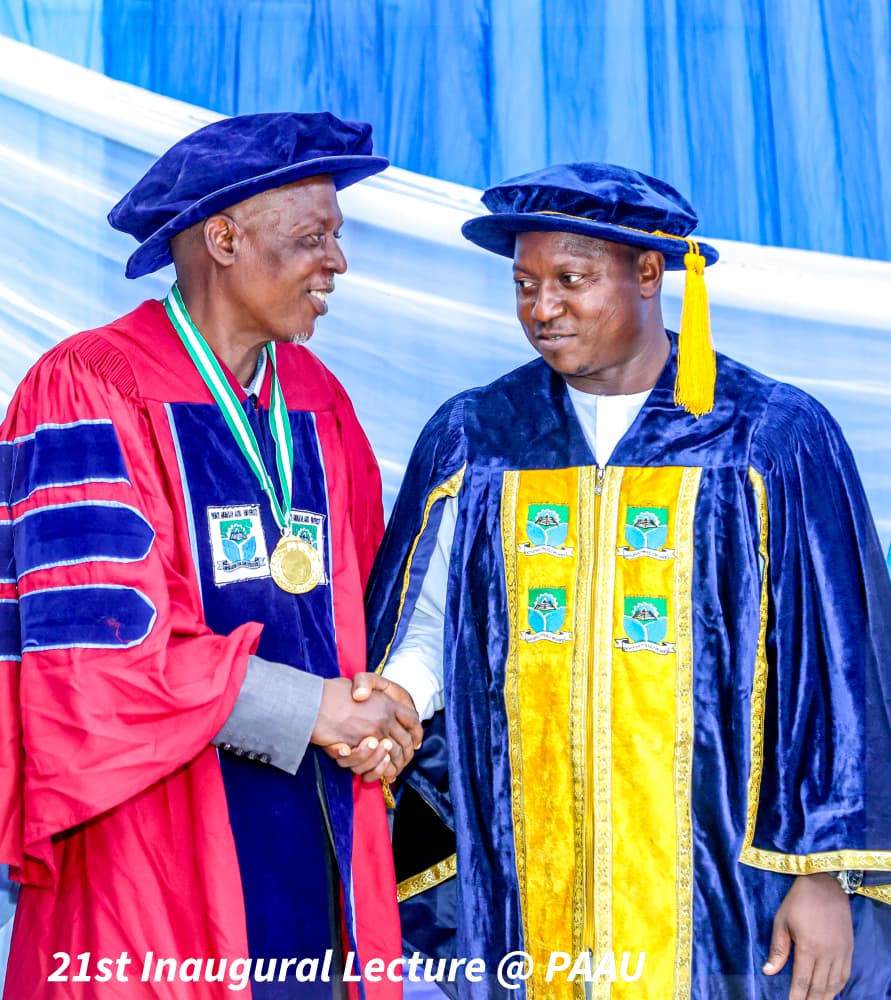
PAAU Don Advocates Environmental Education for Sustainable Development at 21st Inaugural Lecture
By Yahaya Idris
A Professor of Social Studies and Environmental Education at Prince Abubakar Audu University, Professor Joseph Olukayode Ogunbiyi, has called for the deliberate integration of environmental values into Nigeria’s educational system as a strategic pathway to sustainable development.
According to a press release issued by Uredo Omale, Public Relations Officer,
Prince Abubakar Audu University, Anyigba., Professor Ogunbiyi made the call while delivering the 21st Inaugural Lecture of the university on Tuesday at the University Auditorium, Anyigba. The lecture, titled “The Green Classroom: Integrating Environmental Values into Learning,” examined the relationship between environmental education, value formation and sustainable development in contemporary society.
The inaugural lecturer noted that the world is facing a worsening environmental crisis caused by the degradation of natural resources, pollution, deforestation, desertification, and the unchecked consequences of industrialisation and urbanisation. According to him, developing nations, particularly Nigeria, bear a disproportionate share of these environmental challenges.
He described the Green Classroom as an educational model that incorporates environmental values, sustainability practices, eco-friendly behaviour and practical environmental learning into teaching and learning processes.
According to him, classrooms should evolve into living laboratories where students not only learn environmental concepts but also observe, engage with and respond to real-life environmental challenges.
Prof. Ogunbiyi stressed that environmental education should not be treated merely as an academic subject but as a lifelong process involving knowledge acquisition, skill development, value formation, attitude change and active participation in environmental protection.
He traced the evolution of environmental education from the United Nations Conference on the Human Environment, through the Belgrade Charter and Tbilisi Declaration, to the Earth Summit, noting that global consensus has consistently emphasised education as the foundation for environmentally responsible citizenship.
The professor identified inadequate funding, shortage of trained specialists, examination-driven curricula, rapid urbanisation and weak environmental consciousness as major challenges hindering effective environmental education in Nigeria.
Drawing from research and educational theory, he advocated the adoption of Values Analysis and Values Clarification as critical strategies for embedding environmental values in learners. He said these approaches would equip students with logical reasoning, reflective thinking and personal commitment needed for sound environmental decision-making.
Prof. Ogunbiyi further linked environmental education to the United Nations Sustainable Development Goals (SDGs), noting that effective environmental education directly supports SDGs 4, 6, 7, 11, 12, 13, 15 and 17.
He also urged institutions to embrace the waste-to-wealth concept by repositioning waste as a valuable resource within school environments.
As part of his recommendations, the don proposed the establishment of a dedicated Bachelor of Education (B.Ed.) or Bachelor of Science (B.Sc.) degree programme in Environmental Education within the Department of Social Science Education, in line with the National Universities Commission Benchmark Minimum Academic Standards.speaker
He also called on government and university authorities to strengthen environmental education policies, provide adequate funding for environmental learning resources, train more teachers, develop a separate national curriculum for the discipline and encourage nationwide adoption of Green Classrooms.
He concluded that the Green Classroom remains a viable pathway for integrating environmental values into learning, transforming such values into responsible behaviour and ultimately achieving sustainable development.5
Earlier, the Chairman of the Inaugural Lecture Committee congratulated Prof. Ogunbiyi on attaining the prestigious academic milestone.
In his address, the Vice-Chancellor of Prince Abubakar Audu University, Professor Salisu Ogbo Usman, described the 21st Inaugural Lecture as a major milestone in the institution’s intellectual history, noting that it was the fourth inaugural lecture since he assumed office on February 11, 2026.
He said the lecture theme was timely, given the global challenges of climate change, biodiversity loss, desertification, pollution and environmental degradation threatening sustainable development and future generations.
Prof. Usman noted that education remains one of the most powerful tools for societal transformation, with the capacity to shape values, attitudes and behaviours that promote environmental consciousness and responsible citizenship.
He reaffirmed the university’s commitment to supporting impactful research, innovation and academic programmes that promote environmental stewardship and sustainable developmenthe Chairman’s -Chancellor also appreciated the Chairman and members of the Inaugural Lecture Series Committee for sustaining the institution’s culture of scholarship.
In the same vein, Prof. Usman extended condolences to the family and loved ones of Mr. David Ocholi Solomon, a 300-level Biochemistry student whose death has continued to generate grief within the university community.
He assured parents, guardians and the public that the university remains committed to ensuring justice, revealing that suspects connected to the incident were apprehended by the institution’s internal security personnel and handed over to law enforcement agencies for investigation and prosecution.
The Vice-Chancellor congratulated Prof. Ogunbiyi on his academic achievement and commended him for contributing to scholarship and societal development.
The high point of the event was the presentation of the inaugural lecture certificate, plaque and medal to the lecturer.
The lecture attracted members of the University Management, Senate, academic staff, students, traditional rulers, religious leaders, heads of primary and secondary schools, as well as distinguished guests from within and outside the university community.