
Delta’s IGR Revolution: A Testament to Visionary Leadership and Institutional Excellence
By Fred Latimore Oghenesivbe, Esq
Leadership is often measured by the promises it makes. Statesmanship, however, is measured by the institutions it builds and the outcomes it delivers. In an era when sub-national governments across Nigeria are under increasing fiscal pressure, Delta State’s remarkable surge in Internally Generated Revenue (IGR) offers compelling evidence that visionary leadership, supported by strong institutions and disciplined execution, can redefine a state’s economic trajectory.
The increase in Delta State’s IGR from approximately ₦84 billion in 2023 to over ₦200 billion represents more than a 138 percent growth in own-source revenue. It is far more than an impressive fiscal statistic. It is one of the most remarkable improvements in Delta State’s fiscal history and a powerful affirmation of the economic reforms being pursued under the administration of Governor Rt. Hon. Sheriff Oborevwori.
This achievement is especially significant because it was realised without increasing personal income tax rates. At a time when governments around the world are grappling with the difficult balance between revenue generation and protecting citizens from additional fiscal burdens, Delta State has demonstrated that stronger institutions, improved tax administration, and enhanced compliance can deliver sustainable revenue growth without resorting to higher taxation.
Modern public finance teaches that the strength of a tax system lies not merely in its ability to collect more revenue but in its capacity to do so efficiently, equitably, and sustainably. States that broaden their tax base, improve compliance, eliminate leakages, and modernise revenue administration invariably build stronger fiscal foundations than those that depend solely on higher tax rates or volatile external transfers. Delta State’s recent experience validates this principle.
For decades, Nigeria’s fiscal federalism has left many states heavily dependent on oil-derived allocations from the Federation Account. While such revenues remain important, experience has repeatedly shown that overdependence on extractive rents exposes governments to external shocks, commodity price volatility, and uncertain fiscal planning. Sustainable development, therefore, demands a different approach—one anchored on economic diversification, domestic resource mobilisation, and institutional efficiency.
It is precisely this approach that Governor Sheriff Oborevwori has embraced through his M.O.R.E. Agenda. The administration’s emphasis on Meaningful Development, Opportunities for All, Realistic Reforms, and Enhanced Peace and Security reflects an understanding that fiscal sustainability is indispensable to long-term economic prosperity. Development cannot be sustained without a strong revenue base, and a strong revenue base cannot exist without competent institutions.
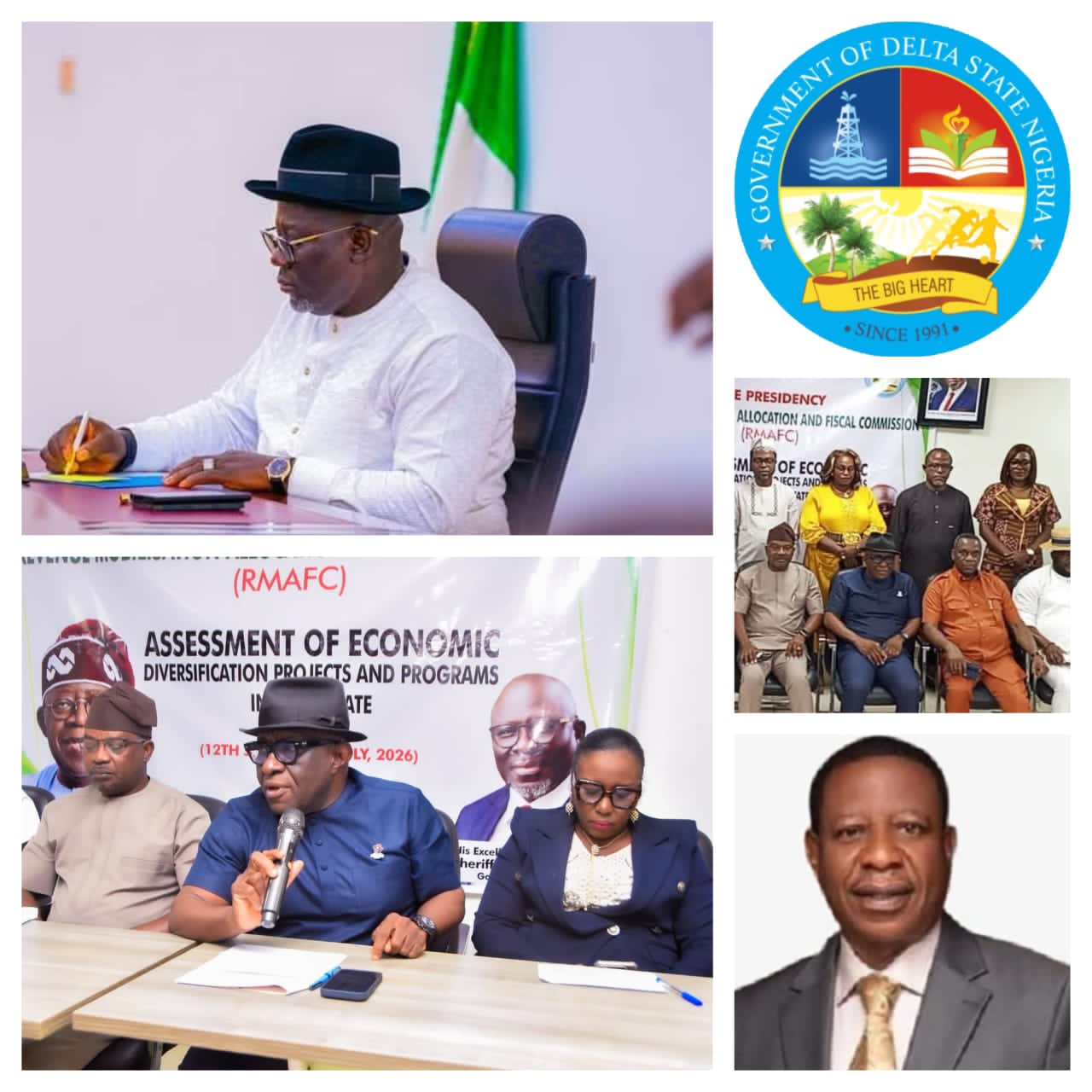
This explains why the commendation recently accorded to Delta State by the Revenue Mobilisation Allocation and Fiscal Commission (RMAFC) carries considerable significance. The Commission’s recognition was not merely an acknowledgment of improved revenue performance; it was an affirmation of a deliberate policy direction that prioritised economic diversification, prudent fiscal management, and sustainable domestic resource mobilisation.
Political leadership, however, achieves little without effective institutions to translate vision into measurable outcomes. Every successful reform agenda requires institutions capable of executing policy with professionalism, innovation, and accountability. In Delta State, that institutional responsibility rests with the Delta State Internal Revenue Service (DSIRS).
As the sole statutory authority responsible for the assessment and collection of state revenues, the DSIRS has become one of the most strategic institutions supporting the Oborevwori administration’s economic agenda. Under the leadership of its Executive Chairman, Chief Solomon Ighrakpata, the Service has undergone a transformation that has significantly strengthened the state’s fiscal architecture.
The defining feature of the current revenue administration is not simply the impressive quantum of revenue collected but the quality of the institutional reforms that have made such growth possible. Rather than adopting the easier path of increasing tax rates, the DSIRS has pursued a more sophisticated and sustainable strategy by expanding the tax net, strengthening voluntary compliance, modernising collection systems, deploying technology, improving taxpayer data management, and closing revenue leakages.
These are not merely administrative adjustments. They are the defining characteristics of modern revenue administration and among the principal drivers of fiscal resilience across successful economies.
Institutional reform is rarely dramatic. It is painstaking, methodical, and often unnoticed until its cumulative impact becomes impossible to ignore. The evolution of the DSIRS under Chief Solomon Ighrakpata exemplifies this reality. Through strategic leadership, administrative innovation, and operational discipline, the Service has evolved beyond its traditional role as a revenue-collecting agency into a critical institution for economic governance. Its contribution to strengthening Delta State’s fiscal capacity has been both substantial and measurable.
Fiscal capacity, the ability of government to finance its development priorities from reliable domestic revenue, is one of the clearest indicators of institutional maturity. States with stronger own-source revenues possess greater fiscal autonomy, enhanced budgetary certainty, and increased capacity to invest in roads, schools, hospitals, security, agriculture, and other public goods that improve the quality of life for citizens. Every additional naira generated through efficient revenue administration expands the government’s ability to fulfil its developmental responsibilities.
It is, therefore, no coincidence that the administration’s impressive revenue performance has occurred alongside deliberate investments in productive sectors of the economy. From agriculture, driven through innovative public-private partnerships, to the ongoing development of the Kwale Industrial Park and renewed efforts to revitalise maritime activities through the Warri and Forcados ports, the Oborevwori administration is laying the foundations for a more diversified and competitive economy.
As productive economic activity expands, the tax base broadens; as the tax base broadens, fiscal capacity strengthens; and as fiscal capacity strengthens, government is better positioned to invest in further development. This virtuous cycle is the hallmark of sustainable economic transformation.
Equally commendable is the synergy between political leadership and institutional performance. Governor Oborevwori has provided the strategic vision, policy clarity, and enabling environment for reform, while Chief Solomon Ighrakpata and the management of the DSIRS have demonstrated the professionalism and competence required to convert policy into measurable fiscal outcomes. Together, they have shown that transformational governance is achieved not through rhetoric but through institutions that consistently deliver results.
The implications extend well beyond Delta State. As Nigeria continues to confront the realities of economic diversification and declining dependence on oil revenues, the experience of Delta provides an instructive model for sub-national governments. It demonstrates that stronger public institutions, efficient revenue administration, and sound economic governance can significantly improve fiscal performance without imposing additional burdens on taxpayers. It is a model rooted in reform, accountability, and institutional excellence.
Naturally, sustaining this momentum will require continued innovation, digital transformation, enhanced taxpayer engagement, and an unwavering commitment to transparency and accountability. Institutional excellence is not a destination but a continuous process of improvement. The progress achieved must therefore serve as a platform for even greater accomplishments in the years ahead.
There is, however, every reason to acknowledge what has already been accomplished. Delta State’s IGR revolution is ultimately more than a revenue story. It is the story of a government that recognised that sustainable development begins with strong institutions; of a Governor who provided the strategic vision for fiscal transformation through the M.O.R.E. Agenda; and of a proactive Delta State Internal Revenue Service, under the exemplary leadership of Chief Solomon Ighrakpata, that translated policy into measurable outcomes through innovation, professionalism, and administrative excellence.
Together, they have demonstrated that visionary leadership, institutional discipline, and sound economic management are the true foundations of fiscal resilience and inclusive development. In doing so, the Oborevwori administration has not only strengthened Delta State’s public finances but also reinforced the proposition that the most enduring legacy of government is not merely the wealth it inherits, but the institutions it builds and the prosperity those institutions make possible.
***
Fred Latimore Oghenesivbe, Esq., is the Director General, Delta State Bureau for Orientation and Communications, Governor’s Office, Asaba. He is a member of the Institute of Legal and Policy Studies.