
BEYOND THE ₦210 TRILLION NARRATIVE: WHY NIGERIANS MUST CHOOSE FACTS OVER SENSATIONALISM
A Tinubu To Lead Perspective on Due Process, Public Accountability, and the Future of National Leadership
In every democracy, there comes a defining moment when the public must decide whether to follow facts or emotions, evidence or speculation, justice or prejudice. Nigeria once again finds itself at such a crossroads following the public debate surrounding the Senate’s scrutiny of financial records associated with the Nigerian National Petroleum Company Limited, (NNPCL).
The public attention generated by discussions around a reported ₦210 trillion has understandably attracted widespread concern. Nigerians have every right to demand transparency in the management of public resources. Every kobo belonging to the Nigerian people deserves accountability, and every public institution must remain subject to constitutional oversight.
These are not merely democratic ideals—they are essential requirements for building a prosperous and trusted nation under President Bola Ahmed Tinubu’s Renewed Hope Agenda.
However, while accountability is indispensable, so too is fairness. Public confidence in democratic institutions is not strengthened when allegations alone become public verdicts. Justice is best served when facts are examined carefully, evidence is tested objectively, and conclusions are reached through lawful processes rather than through social media narratives or political excitement.
That principle should guide every Nigerian’s assessment of the ongoing discourse.
Understanding the Numbers Before Drawing Conclusions
One of the greatest challenges in modern public discourse is that large financial figures often generate more emotion than understanding.
The figure of ₦210 trillion has dominated headlines, leading many citizens to believe that such an amount of money simply disappeared from government coffers. While such headlines naturally provoke concern, responsible public engagement requires Nigerians to ask an important question:
What exactly does this figure represent?
Public reporting indicates that the amount under Senate scrutiny includes accounting entries such as receivables and accrued liabilities that require reconciliation and explanation through established financial procedures. Whether those records are accurate, properly classified, or satisfactorily explained remains the responsibility of the appropriate oversight institutions to determine.
This distinction matters.
Accounting figures appearing in financial records are not automatically equivalent to proven missing cash. Financial statements often contain assets, liabilities, receivables, obligations, and other accounting entries that require professional interpretation before conclusions can responsibly be reached.
Unfortunately, this important distinction has largely been overshadowed by sensational public commentary.
Nigeria deserves better.
Our democracy benefits when citizens demand explanations based on evidence instead of accepting assumptions simply because the figures involved are extraordinary.
Accountability Must Never Be Abandoned
Supporting due process does not mean opposing accountability.
On the contrary, Tinubu To Lead strongly believes that no public institution should operate beyond scrutiny.
The National Assembly has both the constitutional authority and democratic responsibility to examine public expenditure, review financial records, and ask difficult questions where necessary. This oversight role strengthens democracy and protects public resources.
Likewise, every public official must be willing to explain decisions taken while in office.
Transparency should never be feared by honest public servants.
At the same time, constitutional oversight achieves its purpose only when investigations remain professional, objective, and evidence-driven. Public confidence suffers whenever political narratives appear to replace careful examination of facts.
Justice requires balance.
The principles of accountability and the presumption of innocence are not contradictory. They complement one another.
One ensures that wrongdoing is exposed.
The other ensures that innocent people are not condemned without proof.
A mature democracy protects both.
The Importance of Due Process
History has repeatedly shown that public opinion is not always an accurate measure of truth.
Around the world, many individuals have faced serious allegations only for subsequent investigations to establish facts that differed significantly from the initial public narrative.
For this reason, democratic societies insist upon due process.
Due process is not a favour granted to powerful people.
It is a constitutional protection that exists for every citizen.
When allegations arise, institutions investigate.
Evidence is examined.
Questions are answered.
Records are scrutinized.
Only then should conclusions be reached.
This principle becomes even more important when public discourse involves figures large enough to influence national perception and international confidence in Nigeria’s institutions.
No nation benefits when headlines replace evidence.
Lessons from Dr. Bala Maijama’a Wunti’s Senate Appearance
One aspect of the ongoing discussion deserves recognition.
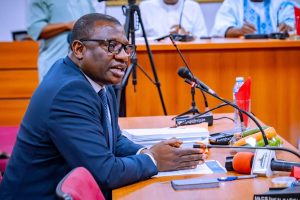
Dr. Bala Maijama’a Wunti did not withdraw from public scrutiny. Instead, he appeared before the Senate Committee and responded to the questions presented to him.
Whether one agrees with every explanation offered is a matter for the oversight process to determine. However, his willingness to engage publicly reflects confidence in constitutional institutions rather than avoidance of them.
Throughout the proceedings, many observers viewed his conduct as composed, articulate, and respectful.
Such public engagement demonstrates an understanding that leadership carries with it the responsibility to answer legitimate questions from democratic institutions.
These observations should not be interpreted as proof regarding the underlying allegations. That determination belongs to the appropriate authorities.
Nevertheless, public composure, respect for institutional oversight, and readiness to provide explanations are qualities worthy of recognition in any public servant.
Leadership Nigeria Must Continue to Encourage
Nigeria’s greatest challenge is not merely finding leaders.
It is finding leaders who combine competence with accountability.
Our nation requires individuals capable of managing complex institutions, communicating difficult issues clearly, remaining calm under pressure, and respecting constitutional oversight.
Leadership should never be measured solely by popularity.
Neither should it be destroyed solely by allegations before lawful processes have run their course.
As President Bola Ahmed Tinubu continues implementing the Renewed Hope Agenda, the search for capable Nigerians who can contribute meaningfully to national development must remain guided by merit, integrity, competence, and commitment to public service.
In the opinion of Tinubu To Lead, Dr. Bala Maijama’a Wunti has demonstrated qualities—including confidence, professionalism, and a willingness to engage with public institutions—that deserve fair and objective consideration alongside every other relevant factor in evaluating individuals for national leadership responsibilities.
This is not a declaration that any ongoing oversight process should be ignored or prejudged. Rather, it is an affirmation that democratic societies should evaluate leaders on the basis of verified facts, demonstrated competence, and the outcomes of lawful institutional processes.
Choosing National Progress Over Political Sensationalism
Nigeria’s democracy will continue to mature only if political actors, the media, civil society, and ordinary citizens commit themselves to responsible public discourse.
https://www.cbc.ca/news/canada/british-columbia/bc-premier-david-eby-alcohol-trump-tariffs-9.7277781
Extraordinary allegations deserve extraordinary evidence.
Serious investigations deserve patience.
Public institutions deserve the opportunity to complete their constitutional responsibilities without undue pressure from sensational narratives.
Likewise, individuals who come under public scrutiny deserve fairness, impartiality, and the full protection of due process guaranteed by the Constitution.
Democracy flourishes when accountability is pursued with integrity rather than political passion.
Conclusion
The Tinubu To Lead platform remains unwavering in its support for transparency, accountability, and institutional reform under President Bola Ahmed Tinubu’s Renewed Hope Agenda.
We believe Nigerians should reject both blind defence and premature condemnation. Neither serves the national interest.
Instead, let us insist upon facts before conclusions, evidence before accusations, and justice before judgment.
As the relevant institutions continue their work, we urge Nigerians to remain patient, objective, and committed to the principles that strengthen democratic governance.
Ultimately, history will remember not those who shouted the loudest, but those who stood firmly for truth, fairness, and the rule of law.
That is the path Nigeria must continue to follow.
Tinubu To Lead
Building Leadership Through Truth, Accountability, and National Unity.