
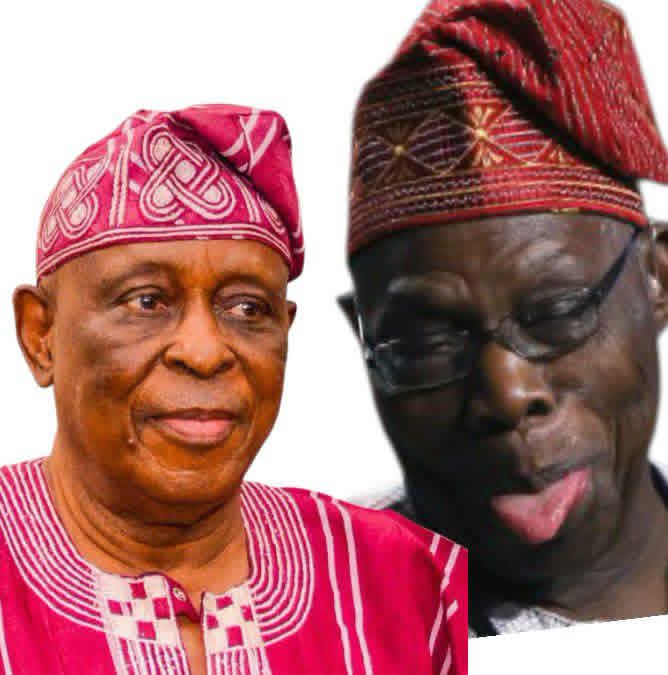
Obasanjo Fires Back at Osoba Over 2003 Election Claims, Says ‘You Lied’
Former President Says Ex-Ogun Governor Misrepresented History, Insists Southwest Political Events Were ‘Beyond Your Understanding’
By Yahaya Idris
Former President Olusegun Obasanjo has vehemently rejected claims by former Ogun State Governor, Chief Olusegun Osoba, that he deceived governors elected on the platform of the defunct Alliance for Democracy (AD) ahead of the 2003 general elections, describing the allegations as false and historically inaccurate.
In a lengthy open letter dated July 23, 2026, Obasanjo accused Osoba of presenting a distorted account of political events leading to the 2003 elections, insisting that several key developments occurred beyond the former governor’s knowledge and involvement.
The former president said Osoba’s narrative, published in The Legal Observer on July 20, 2026, contained numerous inaccuracies and omitted critical facts that shaped the political scene at the time.
Obasanjo Rejects ‘Deceit’ Allegation
Obasanjo took particular exception to Osoba’s characterization of him as deceitful, maintaining that he had always acted transparently throughout his political career.
“I take strong and serious objection to your calling me a deceit because I deceived nobody,” Obasanjo wrote.
According to him, he consistently presented issues “as I had them and as I understood them,” regardless of whose interests were affected.
He argued that many of the political negotiations and strategic discussions preceding the 2003 elections were handled by senior leaders of the Alliance for Democracy and Afenifere, rather than by the Southwest governors themselves.
“There were issues you did not know or understand because, as you pointed out, they were above your head,” Obasanjo stated.
Recounts Presidential Journey
The former president used the letter to narrate events following his release from prison, explaining how several political groups encouraged him to contest Nigeria’s presidency.
He recalled consultations with prominent political leaders across the South-West, North and South-East before eventually joining the Peoples Democratic Party (PDP).
Among those he said he consulted were the late Chief Bola Ige, Chief Richard Akinjide, Chief Michael Akinloye, Professor Oyeleye, Adamu Ciroma, Sunday Awoniyi, Professor Anezi Okoro and Arthur Mbanefo.
According to Obasanjo, his political philosophy has always emphasized dialogue, inclusiveness and national unity rather than bitterness or partisan hostility.
Jimmy Carter Meeting and Bola Ige Encounter
One of the central revelations in the letter concerned events before the 1999 presidential election.
Obasanjo recalled meeting former United States President Jimmy Carter, who visited Nigeria to encourage peaceful elections.
During the visit to the Sheraton Hotel in Ikeja, Lagos, Obasanjo said he briefly encountered the late Chief Bola Ige.
He quoted their exchange:
“I asked, ‘Bola, how now? I met you in Ibadan and you said there would be fence-mending to do. Have you done the fence-mending for me?'”He replied, ‘We will meet in the field.'”We never met in the field. That was above your head.”
Obasanjo cited the conversation as evidence that many political negotiations were unknown to Osoba.
Defends National Unity Strategy
Responding to allegations that he sought support from Alliance for Democracy governors out of political weakness, Obasanjo dismissed the claim.
He argued that after winning the presidency with support from across Nigeria, his decision to include AD politicians in government reflected his commitment to national integration rather than political desperation.
He noted that although the PDP secured governorship victories in 21 states, it failed to win the South-West.
According to him, bringing opposition politicians into government was aimed at ensuring Yoruba participation in national governance. “I rather make friends than enemies,” Obasanjo wrote.
Addresses 2003 Elections
The former president rejected suggestions that the outcome of the 2003 elections resulted from manipulation orchestrated by him.
Instead, he argued that the Alliance for Democracy governors underestimated the PDP’s campaign strength while relying on political arrangements that never materialized.
He claimed the six AD governors believed an understanding existed that would guarantee their re-election in 2003.
Obasanjo alleged that such assurances were promoted by political actors without his approval.
He insisted he neither endorsed nor participated in any anti-democratic arrangement designed to protect incumbents.
Vice President Impeachment Allegation
The former president also made fresh allegations regarding an impeachment plot during his first term in office.
Obasanjo claimed that while he was away from Abuja on official duties, his then Vice President allegedly encouraged former Speaker of the House of Representatives Ghali Na’Abba to initiate impeachment proceedings against him.
According to Obasanjo, intelligence reports indicated that financial support was provided to commence the process.
He maintained that he treated the impeachment efforts with contempt because he believed he had committed no impeachable offence.
Defends Political Philosophy
Throughout the letter, Obasanjo repeatedly emphasized that politics should be based on ideas, dialogue and national development rather than ethnic loyalty.
He criticized what he described as tribal politics, arguing that Nigeria’s democracy requires leaders capable of building bridges across regional and partisan divides.
He also defended his long-standing practice of maintaining cordial relationships with political opponents regardless of party affiliation.
Pays Tribute to Osoba Despite Disagreement
Despite the sharp criticism, Obasanjo concluded the letter by acknowledging Osoba’s contribution to the establishment of the Olusegun Obasanjo Presidential Library (OOPL) in Abeokuta.
He thanked the former governor for allocating the land on which the library was built, describing the project as one of Ogun State’s most significant landmarks.
According to Obasanjo, the allocation was made in the public interest without political considerations.
He urged Osoba to reflect on the lessons of history, embrace humility and recognize that political rivalry should never destroy personal relationships.
Political Significance
Obasanjo’s response comes after renewed public debate over the political events surrounding Nigeria’s 1999 and 2003 elections, particularly the collapse of the Alliance for Democracy’s dominance in the South-West.
The exchange between two of Ogun State’s most influential political figures has revived discussion about the alliances, negotiations and rivalries that shaped Nigeria’s return to democratic rule.
While Osoba had accused the former president of deceiving Southwest governors, Obasanjo insists the claims are unfounded and that the historical record tells a different story.