
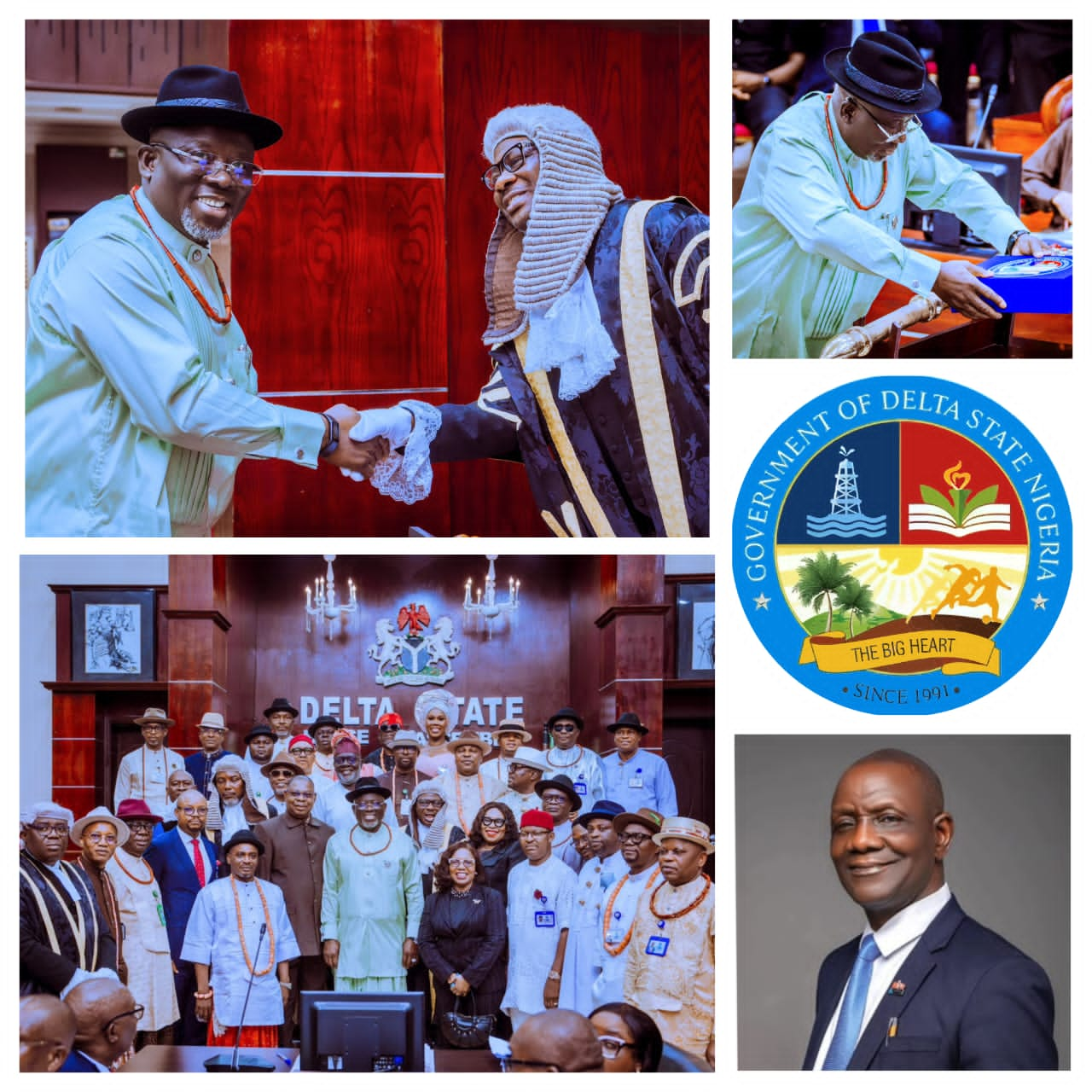
By Dr Wilfred Latimore Oghenesivbe, Esq.
The presentation of the Delta State 2027 Appropriation Bill by Governor Sheriff Oborevwori marks another significant milestone in the state’s development journey and reinforces his administration’s commitment to sustainable growth, infrastructure renewal, human capital development and improved living standards.
With a proposed expenditure of N1.23 trillion, aptly tagged the Budget of Sustained Prosperity and Enhanced Growth, the proposal reflects a purposeful vision of governance in which economic opportunities, social investments and physical development are strategically aligned to deliver tangible benefits to the people. It is a budget designed to consolidate achievements, strengthen ongoing programmes and accelerate the transformation of Delta State.
At the heart of the proposal is a clear demonstration of fiscal responsibility and development-oriented leadership. The allocation of N806.8 billion, representing approximately 65 per cent of the total budget, to capital expenditure, against N430 billion for recurrent expenditure, underscores the administration’s determination to direct a substantial proportion of public resources towards projects and investments that create enduring value.
This capital-intensive approach is particularly commendable because infrastructure, productive assets and public facilities remain essential foundations for economic expansion, employment generation and improved quality of life. The proposed budget therefore speaks to a government that understands the importance of investing in the future while meeting present-day obligations.
The decision to adopt a more realistic spending framework, following the reduction from the N1.729 trillion approved for 2026, equally demonstrates prudent financial management. Budgetary responsibility is not measured solely by the size of government expenditure but by the capacity to align revenue expectations with achievable development objectives.
Governor Oborevwori’s emphasis on fiscal discipline, completion of ongoing projects and consolidation of existing achievements provides a sound framework for effective implementation. This approach will enhance value for money, promote accountability and ensure that available resources are channelled towards priorities that directly improve the welfare of Deltans.
Infrastructure development remains one of the most visible pillars of the Oborevwori administration’s development agenda. The reported execution of 872 road projects and 20 bridges and flyovers since the inception of the administration, covering 2,348 kilometres of roads and 1,871 kilometres of drainage infrastructure, represents an ambitious programme of connectivity and urban and rural renewal. These investments are particularly important in a state with diverse geographical, commercial and environmental characteristics.
Good roads connect communities, facilitate the movement of agricultural produce, improve access to markets, reduce transportation difficulties and create an enabling environment for businesses to flourish. They also strengthen social integration by bringing communities closer to essential public services and economic opportunities.
The proposed N320 billion allocation to the two Ministries of Works is therefore a strategic investment in the continued transformation of Delta State. It will support the completion of ongoing road and bridge projects, sustain new infrastructure interventions and reinforce the administration’s commitment to delivering durable public assets across the three senatorial districts.
Of particular importance is the attention being given to rural and riverine communities, where roads, bridges and jetties are critical to mobility, commerce and access to healthcare and education. By responding to the infrastructure priorities identified through community consultations, Governor Oborevwori is demonstrating a participatory approach to governance in which development planning is informed by the needs and aspirations of the people.
Beyond road infrastructure, the proposed investments in the Delta State Capital Territory Development Agency and the Warri-Uvwie and Environs Development Agency, with N20 billion allocated to each, demonstrate a broader appreciation of the relationship between urban development, economic productivity and environmental sustainability. Well-planned urban centres attract investment, stimulate commercial activities and improve the quality of public spaces.
Similarly, the N12 billion proposed for the energy sector reinforces the administration’s commitment to strengthening electricity infrastructure and supporting the expansion of economic activities. The reported execution of 2,155 energy projects, including transformers, solar streetlights and power-grid extensions, further illustrates the practical dimensions of this development agenda. Improved electricity access will support small businesses, enhance community security and contribute to a more productive economy.
Education occupies a central position in the proposed budget, with an allocation of N74 billion reflecting the administration’s recognition that human capital is the most valuable resource for sustainable development. The distribution of the allocation across primary, technical, secondary and higher education demonstrates a comprehensive approach to building an educational system that caters to learners at different stages of their academic and professional development.
The proposed N40 billion for higher education, N12 billion for secondary education, N12 billion for technical education and N10 billion for primary education provide a foundation for strengthening educational institutions, improving learning conditions and expanding opportunities for academic advancement. This investment is particularly significant because the future competitiveness of Delta State depends substantially on the quality of education and skills available to its young population.
The emphasis on school rehabilitation, teacher development, digital learning, laboratories and accreditation of academic programmes further reinforces the quality-oriented character of the administration’s education policy. The approval of N10.8 billion for the rehabilitation and renovation of primary and secondary schools is an important intervention that will improve the learning environment for pupils and students across the state.
Functional classrooms, well-equipped laboratories, modern teaching facilities and motivated teachers are essential ingredients of effective education delivery. Equally, investments in technical education will equip young people with practical and employable skills, positioning them to benefit from emerging opportunities in construction, manufacturing, technology, agriculture and other productive sectors. By strengthening education at all levels, Governor Oborevwori is investing in a generation of competent, innovative and self-reliant Deltans.
Healthcare development is another important component of the proposed budget, with N50 billion earmarked to strengthen the state’s healthcare delivery system. This allocation will support hospital upgrades, medical supplies, recruitment and improved welfare of healthcare personnel. These interventions are essential to building a responsive healthcare system that provides accessible and quality medical services to residents, particularly women, children, senior citizens and vulnerable populations.
Healthcare infrastructure must be supported by competent medical professionals, functional equipment, adequate supplies and a conducive working environment. The administration’s proposed investment in these areas demonstrates an understanding that the wellbeing of citizens is inseparable from the overall development of the state. A healthy population is more productive, economically active and better positioned to contribute to societal progress.
The establishment and operational development of the College of Health Technology, Ovrode, which has enrolled more than 800 pioneer students, is another commendable initiative with long-term benefits for the healthcare sector. The institution represents a strategic investment in the training and development of essential healthcare manpower. As demand for quality medical services continues to grow, the availability of trained health technicians and allied professionals will be crucial to strengthening healthcare delivery, especially at the community and primary healthcare levels.
By expanding opportunities for specialised health education within the state, the Oborevwori administration is creating a sustainable pathway for local capacity development, professional advancement and employment generation. This initiative also complements the proposed healthcare expenditure by addressing not only infrastructure needs but the human resource requirements of the health sector.
The administration’s commitment to economic diversification and investment promotion equally deserves recognition. Delta State possesses enormous economic potential across agriculture, industry, entertainment, commerce and small and medium-scale enterprises. The proposed budget provides an opportunity to consolidate these advantages through strategic partnerships with the private sector and the creation of a more favourable business environment.
The $70 million Olam Agri feed mill project at Ogwashi-Uku, identified as one of the outcomes of the 2026 Delta State Economic and Investment Summit, is an encouraging example of how investment promotion can translate into productive economic activities.
Beyond the immediate employment opportunities, the project has the potential to strengthen agricultural value chains, create markets for locally produced commodities and improve the income prospects of farmers and other participants in the agricultural economy. Such investments demonstrate the importance of connecting government policy with private-sector enterprise.
The reported growth of Delta State’s Internally Generated Revenue from N83 billion in 2023 to a projected N283 billion by December 2026 is another positive indicator of the administration’s economic and institutional reforms. The adoption of technology-driven revenue collection, expansion of the revenue base and efforts to eliminate leakages without imposing additional tax burdens reflect a commitment to improving public finance through efficiency and innovation.
Equally noteworthy is the repayment of N400 billion out of N463 billion in legacy debt, leaving an outstanding balance of N63 billion, which the governor expressed confidence would be cleared by the end of the first quarter of 2027. These developments demonstrate a conscious effort to strengthen the state’s financial position, improve its capacity to fund development priorities and preserve fiscal stability for future generations.
The reported increase in the state’s Gross Domestic Product from N14.5 trillion in 2024 to approximately N17.9 trillion in 2025, making Delta Nigeria’s fifth-largest state economy, further provides encouraging context for the administration’s economic development ambitions.
The proposed N50 billion allocation to the 25 local government areas is equally significant because sustainable development must be inclusive and must extend beyond major urban centres. Local governments are closest to the grassroots and play important roles in community development, primary healthcare, basic education, sanitation and other essential services. Strengthening their financial capacity can improve service delivery and deepen the impact of government programmes at the community level.
The N5 billion proposed for agriculture and another N5 billion for social interventions also reinforce the administration’s recognition of the importance of food production, livelihood support and social inclusion. These allocations, alongside investments in urban planning and energy, reflect a development philosophy that seeks to balance economic growth with the social needs of ordinary citizens.
The welfare of public servants also receives commendable attention in the Oborevwori administration’s governance agenda. The governor’s assent to the 13th-month salary bill, commencing in December 2026, is a demonstration of appreciation for the dedication and contributions of workers to public service delivery and state development. This initiative provides additional financial support to public servants, particularly during the festive season, while reinforcing the importance of a motivated workforce in achieving government objectives.
Similarly, the administration’s continued collaboration with security agencies, approval for the construction of 25 police divisional headquarters for state police and plans to recruit 1,000 forest guards demonstrate a proactive approach to strengthening the security architecture. Peace and security remain indispensable to investment, commerce, agriculture, education and the effective implementation of development programmes.
The success of an ambitious budget also depends on effective collaboration among the institutions of government. In this regard, the cordial relationship between the executive and legislative arms of Delta State deserves commendation. The supportive remarks of the Speaker of the House of Assembly, Rt. Hon. Emomotimi Guwor, particularly his recognition of the administration’s achievements in infrastructure, healthcare, education, social welfare and human capital development, underscore the importance of institutional cooperation.
The commitment of the House to the legislative consideration of the Appropriation Bill provides an opportunity for constructive engagement and the strengthening of the budgetary process. Such cooperation, anchored on constitutional responsibilities and a shared commitment to public welfare, creates a conducive environment for continuity, policy stability and accelerated development.
Ultimately, the 2027 Budget of Sustained Prosperity and Enhanced Growth represents more than an annual statement of projected revenue and expenditure; it is a development instrument designed to translate the aspirations of Deltans into measurable improvements in their everyday lives. Its emphasis on capital expenditure, roads and bridges, education, healthcare, electricity, agriculture, social interventions, investment promotion and security provides a comprehensive framework for advancing inclusive prosperity.
The benefits will be reflected in improved transportation, better learning environments, stronger healthcare services, expanded employment opportunities, increased commercial activities and enhanced access to essential public infrastructure. With effective implementation, prudent resource management and sustained institutional collaboration, the budget has the capacity to deepen the gains of the MORE Agenda and strengthen Delta State’s position as a leading subnational economy in Nigeria.
Governor Sheriff Oborevwori deserves commendation for his visionary leadership, developmental foresight and unwavering commitment to the prosperity of Delta State. His administration’s emphasis on practical governance, infrastructure renewal, fiscal responsibility, human capital development and inclusive economic growth reflects a leadership philosophy that places the people at the centre of public policy.
The 2027 budget proposal provides another opportunity to consolidate these priorities and advance the collective aspiration for a stronger, more prosperous and economically competitive Delta State. As the state looks towards the new fiscal year, the expectation is that the proposed investments will translate into visible and enduring benefits for communities, families, workers, entrepreneurs, students, farmers and other stakeholders.
Indeed, with purposeful leadership, responsible governance and collective commitment, the vision of sustained prosperity and accelerated development remains firmly within reach. Delta State is moving forward, and the Oborevwori administration is steadily building a legacy of development, opportunity and shared prosperity.
***
Dr Wilfred Latimore Oghenesivbe, Esq, is the Director-General of the Delta State Bureau for Orientation and Communications, Governor’s Office Asaba. He’s a member of the Association of Communication Scholars and Professionals of Nigeria (ACSPN).