
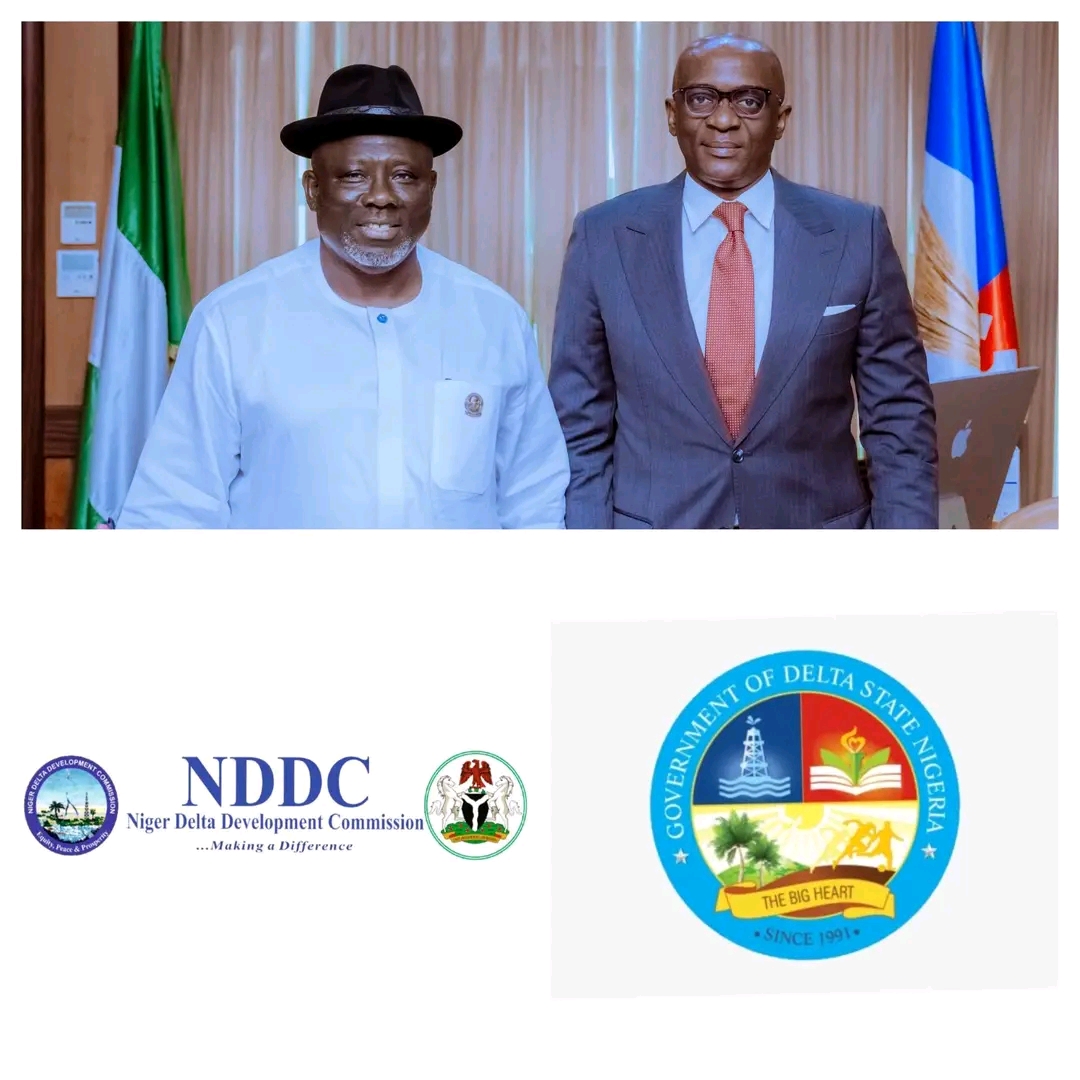
Renewed Synergy: NDDC–Delta State Partnership for More Development
By Fred Latimore Oghenesivbe, Esq.
Development commissions are established to bridge infrastructure deficits, stimulate economic growth and improve the quality of life of citizens in regions requiring special intervention. That is the fundamental philosophy behind the establishment of the Niger Delta Development Commission (NDDC), one of Nigeria’s foremost regional development agencies.
Established by an Act of the National Assembly in 2000, the NDDC was conceived as the Federal Government’s intervention vehicle for the sustainable development of the nine oil-producing states of the Niger Delta: Abia, Akwa Ibom, Bayelsa, Cross River, Delta, Edo, Imo, Ondo and Rivers.
The Commission’s mandate extends beyond physical infrastructure to encompass environmental remediation, healthcare, education, transportation, electricity, potable water, agriculture, youth and women empowerment, job creation, ecological protection and human capital development. Its overarching mission is to transform the Niger Delta into a region that is economically prosperous, socially stable, environmentally sustainable and politically peaceful.
Over the past two decades, the Commission has intervened in virtually every sector of regional development through the construction of roads and bridges, rural electrification, water schemes, healthcare facilities, educational infrastructure, shoreline protection, erosion control, skills acquisition centres, scholarship programmes and enterprise development initiatives. Although the Commission has faced institutional challenges at different periods, its strategic relevance to the development of the Niger Delta has never been in doubt.
Since the inauguration of the present Governing Board in November 2023, under the chairmanship of Chief Chiedu Ebie, Esq., with Dr. Samuel Ogbuku as Managing Director and Chief Executive Officer, the Commission has pursued a renewed emphasis on institutional stability, corporate governance, project completion, stakeholder engagement and improved service delivery. The Board has consistently projected the NDDC as a development institution driven by partnerships, accountability and measurable impact across the region.
Delta State has continued to benefit from this renewed development approach. In Ika Federal Constituency, the Commission completed and equipped a modern Information and Communication Technology Centre for the Faculty of Law, University of Delta (UNIDEL), Agbor, providing students with contemporary digital learning facilities.
The Commission also commenced the rehabilitation of the failed section of the Umunede–Umutu Road at Owa-Alidinma, an intervention designed not only to restore connectivity but also to address the flooding that had threatened the corridor. Under the “Light Up the Niger Delta” initiative, solar-powered street lighting projects have also enhanced security, commercial activities and the night-time economy in several communities.
These interventions underscore an important reality: development is most impactful when federal intervention agencies and state governments work in strategic alignment. Projects are better prioritised, implementation is more effectively coordinated, duplication is minimised and public resources deliver greater value.
It is against this background that the recent courtesy visit by the Chairman of the NDDC Governing Board, Chief Chiedu Ebie, to the Governor of Delta State, Rt. Hon. (Elder) Sheriff F. O. Oborevwori, assumes considerable significance.
Following the meeting at Government House, Asaba, Chief Ebie explained on his verified social media platforms that the visit was aimed at strengthening the cordial relationship between the Commission and the Delta State Government while reaffirming their shared commitment to the development and wellbeing of the people of Delta State.
Development in today’s Nigeria increasingly depends on institutional collaboration rather than isolated government action. No single tier of government possesses sufficient resources to address infrastructure deficits, environmental degradation, youth unemployment and the growing demand for social services. The most successful development models are those built on cooperation among federal institutions, state governments, local authorities and the private sector.
For Delta State, the dividends of stronger collaboration with the NDDC are potentially enormous. A more coordinated partnership can accelerate the delivery of strategic roads linking agricultural communities to urban markets, improve erosion control and shoreline protection in vulnerable riverine areas, expand rural electrification and potable water schemes, strengthen healthcare infrastructure, modernise educational facilities and deepen investments in digital technology. Such interventions not only improve living standards but also stimulate productivity, reduce the cost of doing business and create new economic opportunities.
Equally significant is the potential impact on human capital development. Expanded scholarship schemes, vocational education, digital skills training, entrepreneurship support and youth empowerment programmes can equip thousands of young Deltans with the capacity to compete in a knowledge-driven economy. Long-term prosperity is built not only on roads and buildings but also on educated, skilled and productive citizens.
The economic implications are equally compelling. Better infrastructure attracts investment. Improved connectivity expands commerce. Reliable electricity supports small and medium-scale enterprises. Environmental protection safeguards livelihoods in coastal communities. Coordinated development planning strengthens investor confidence and encourages public-private partnerships capable of unlocking the enormous economic potential of Delta State.
The evolving political relationship between Delta State and the Federal Government also presents an opportunity for closer institutional engagement. While development should never be reduced to partisan considerations, constructive cooperation between governments often enhances policy coordination, facilitates project implementation and strengthens access to federal intervention programmes that directly benefit the people.
Chief Chiedu Ebie brings to the NDDC extensive experience in governance, law and public administration, including his previous service as Commissioner and Secretary to the Delta State Government. His understanding of Delta State’s developmental priorities, combined with Governor Sheriff Oborevwori’s commitment to infrastructure expansion and inclusive growth, provides a solid foundation for productive engagement between the Commission and the state.
Essentially, the significance of the Asaba meeting lies not merely in the symbolism of a courtesy visit but in what it represents, a renewed resolve to build partnerships capable of accelerating development across Delta State.
That is the true promise of greater synergy. That is the pathway to a more prosperous Delta State.
***
Fred Latimore Oghenesivbe, Esq, is the Director-General of the Delta State Bureau for Orientation and Communications, Governor’s Office Asaba. He is a member of the Association of Communication Scholars and Professionals of Nigeria (ACSPN).