
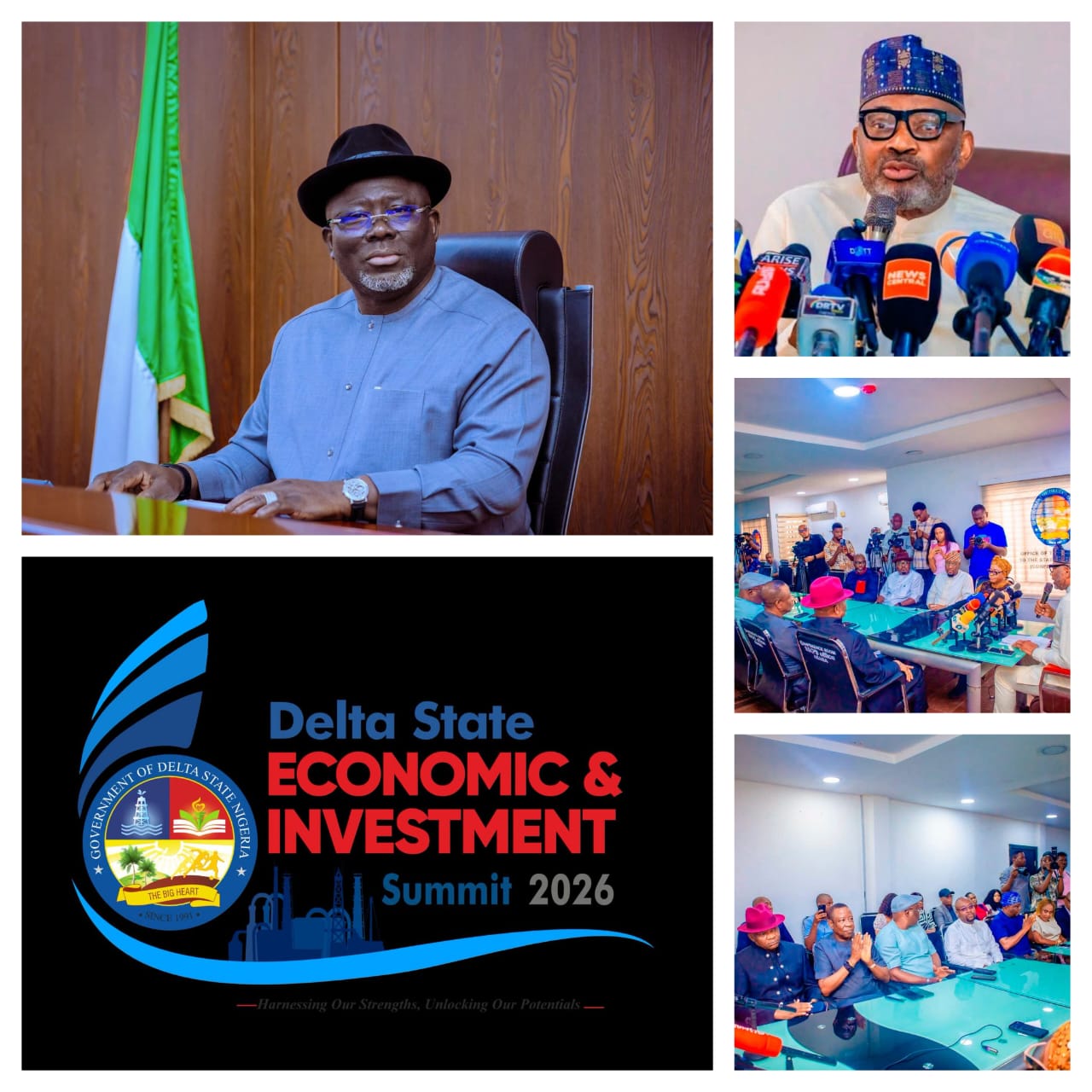
DSEIS 2026: Oborevwori’s Strategy for Building Nigeria’s Next Industrial Growth Hub
…Summit to Hold August 3–5 in Asaba.
By Fred Latimore Oghenesivbe, Esq.
Economic transformation is rarely accidental. It is the product of strategic planning, sustained infrastructure investment, sound public policy, and the confidence to attract private capital into productive sectors of the economy. These principles underpin the Delta State Economic and Investment Summit 2026, an initiative that demonstrates Governor Sheriff Oborevwori’s determination to reposition Delta from a resource-rich state into one of Nigeria’s foremost industrial and investment destinations.
Holding from August 3 to 5 in Asaba, the summit is designed not merely as an investment conference but as a business platform for mobilising domestic and foreign capital into sectors capable of accelerating industrialisation, expanding productive capacity, creating thousands of jobs and increasing economic output. More significantly, it is expected to culminate in the signing of more than five strategic Memoranda of Understanding (MoUs), signaling growing investor confidence in Delta’s long-term economic prospects.
During the pre-summit briefing in Asaba, the Secretary to the State Government, Dr. Kingsley Emu outlined the administration’s investment priorities around thematic areas that reflect Delta’s comparative advantages and long-term economic vision. These include infrastructure-driven industrialisation; agriculture and agro-industrial value chains; the Delta Special Economic Zone and affordable energy; the blue economy; mining and solid minerals development; strategic transport and maritime connectivity; and international investment partnerships. Together, these pillars form a coherent economic blueprint designed to attract long-term investment, deepen industrialisation, diversify the economy, create sustainable jobs, increase Internally Generated Revenue (IGR) and accelerate Gross Domestic Product (GDP) growth.
https://globaltimesnigeria.com/2026/07/22/why-2027-is-not-ogboru-time-oborevwori-continuity/
Infrastructure remains the first and perhaps most critical pillar. Investors follow infrastructure because it lowers operating costs, improves logistics, and enhances business competitiveness. Over the past three years, Governor Oborevwori’s administration has constructed and rehabilitated more than 2,600 kilometers of roads and over 20 bridges, linking production centres with markets and strengthening commercial corridors across the state. These investments have reduced transaction costs and improved the ease of doing business, making Delta increasingly attractive for manufacturing, agro-processing, logistics, and industrial production.
The Delta Special Economic Zone constitutes another major investment proposition. Globally, Special Economic Zones have become engines of industrialisation by attracting export-oriented manufacturing, technology transfer, and large-scale private investment. Delta enjoys a distinct advantage because the zone is supported by proximity to the OB-3 Gas Pipeline, providing investors with access to relatively affordable and reliable energy, one of the most decisive factors influencing industrial investment decisions. Lower energy costs improve productivity, enhance profitability, and increase the competitiveness of locally manufactured goods in both domestic and international markets.
Beyond energy security, the Special Economic Zone provides the platform for integrated industrial clusters where manufacturers, processors, logistics operators, and service providers can operate within a single ecosystem. Such industrial agglomeration encourages economies of scale, promotes technology diffusion, and generates significant employment across multiple value chains.
Equally significant is the summit’s emphasis on the blue economy, one of the fastest-growing sectors in global commerce. With four seaports, two airports, and a 163-kilometre Atlantic coastline, Delta possesses strategic maritime assets capable of supporting a diversified ocean economy. The state’s investment focus extends beyond traditional fishing to commercial aquaculture, fish feed manufacturing, seafood processing, cold-chain logistics, marine transportation, and export-oriented fisheries. These subsectors present attractive opportunities for private investment while creating sustainable employment and expanding non-oil export earnings.
The development of an integrated blue economy also positions Delta to become a regional hub for marine logistics and seafood processing, leveraging its geographical advantages to generate greater value from maritime resources. Such investments can strengthen food security, stimulate rural enterprise, and improve household incomes across coastal communities.
Agriculture represents another strategic pillar in Governor Oborevwori’s economic transformation agenda. Beyond its hydrocarbon wealth, Delta is richly endowed with fertile alluvial soils, abundant rainfall, extensive freshwater resources, and favourable climatic conditions that support year-round commercial agriculture. The agricultural belts of Ndokwa East and West, Ukwuani, Aniocha North, Ika North East, Ika South, Oshimili North, Ethiope East, Ethiope West, Ughelli North and parts of Isoko North possess enormous comparative advantages in the cultivation of cassava, rice, maize, yam, oil palm, rubber, cocoa, plantain, vegetables and a wide variety of fruits. Combined with thriving aquaculture clusters in Udu, Uvwie, and Warri South, Delta has the natural endowments to emerge as Nigeria’s leading hub for integrated agriculture, aquaculture and food processing.
For investors, however, the greatest opportunity lies beyond cultivation and across the agricultural value chain, where the highest economic value is created. Large-scale mechanised farming, supported by precision agriculture, irrigation systems, improved seed technology, fertiliser blending plants, commodity aggregation centres, modern silos, cold-chain logistics, agro-processing parks and export packaging facilities, can transform Delta into a regional food basket and agro-export powerhouse.
Investments in cassava processing into industrial starch, ethanol and high-quality flour; integrated rice production and milling; palm oil refining; rubber processing; fruit juice concentrates; animal feed mills; poultry and livestock production; and food packaging industries would significantly expand the state’s manufacturing base while creating thousands of direct and indirect jobs. They would strengthen food security, reduce Nigeria’s dependence on food imports, boost non-oil exports, increase foreign exchange earnings, attract substantial foreign direct investment, and expand the state’s internally generated revenue. By deliberately integrating commercial agriculture with manufacturing, logistics and export markets, Governor Oborevwori’s administration is positioning agriculture not merely as a rural occupation but as a high-value industrial enterprise capable of driving inclusive economic growth and long-term prosperity.
Mining and solid minerals development represent another strategic growth frontier. Delta’s commercially viable deposits of coal, lignite, kaolin, and silica provide opportunities for mineral processing, ceramics manufacturing, cement production, construction materials, and coal-based power generation. Rather than exporting raw minerals, the emphasis is on developing downstream industries that retain value within the state, encourage technology transfer, and expand industrial output. This approach aligns with global best practices in resource-based industrialisation, where value addition generates higher incomes, stronger supply chains, and greater fiscal returns.
Transport and maritime connectivity further reinforce Delta’s investment proposition. The efficient movement of goods remains fundamental to industrial competitiveness. The combination of extensive road infrastructure, seaports, airports, and coastal access creates an integrated logistics network capable of supporting manufacturing, exports, and regional trade while lowering supply chain costs and improving market access.
The summit also reflects Governor Oborevwori’s deliberate investment diplomacy. Over the past three years, the administration has engaged prospective investors across China, Brazil, and other strategic markets, promoting Delta’s investment opportunities and building relationships with global businesses seeking new destinations for expansion. The expected participation of foreign investors from these economies demonstrates growing international confidence in Delta’s investment climate and governance stability.
Perhaps the most significant outcome expected from the summit is the execution of more than five strategic Memoranda of Understanding across the identified sectors. These agreements are expected to unlock substantial domestic and foreign direct investment, facilitate technology transfer, establish new manufacturing and processing plants, stimulate agro-industrial and marine enterprises, deepen mineral development, and expand export-oriented industries. Once translated into bankable projects, the MoUs will accelerate capital formation, strengthen industrial value chains, create thousands of jobs, increase productivity, and broaden Delta’s economic base. Their cumulative impact will be reflected in stronger GDP growth, higher internally generated revenue, improved household incomes, and a more resilient, diversified economy that is less dependent on federally distributed oil revenues
Viewed from this perspective, the Delta State Economic and Investment Summit 2026 is a strategic economic policy instrument designed to mobilise investment, accelerate industrialisation, and reposition Delta within Nigeria’s emerging competitive economy.
Governor Sheriff Oborevwori deserves credit for recognising that sustainable prosperity is built not only through public expenditure but by creating an enabling environment in which private capital can flourish. By aligning infrastructure development with investment promotion, energy security, maritime development, industrial clustering, and international partnerships, his administration is laying the foundation for a more diversified, resilient, and globally competitive economy.
If the summit delivers on its objectives, and the economic indicators suggest that it can, Delta State will move beyond being one of Nigeria’s leading resource-producing states to becoming one of the nation’s foremost centres of industrial production, investment attraction and sustainable economic growth. That would not only define the legacy of the Oborevwori administration but also reshape the economic future of Delta for generations to come.
***
Fred Latimore Oghenesivbe, Esq, is the Director-General of the Delta State Bureau for Orientation and Communications, Governor’s Office Asaba.