
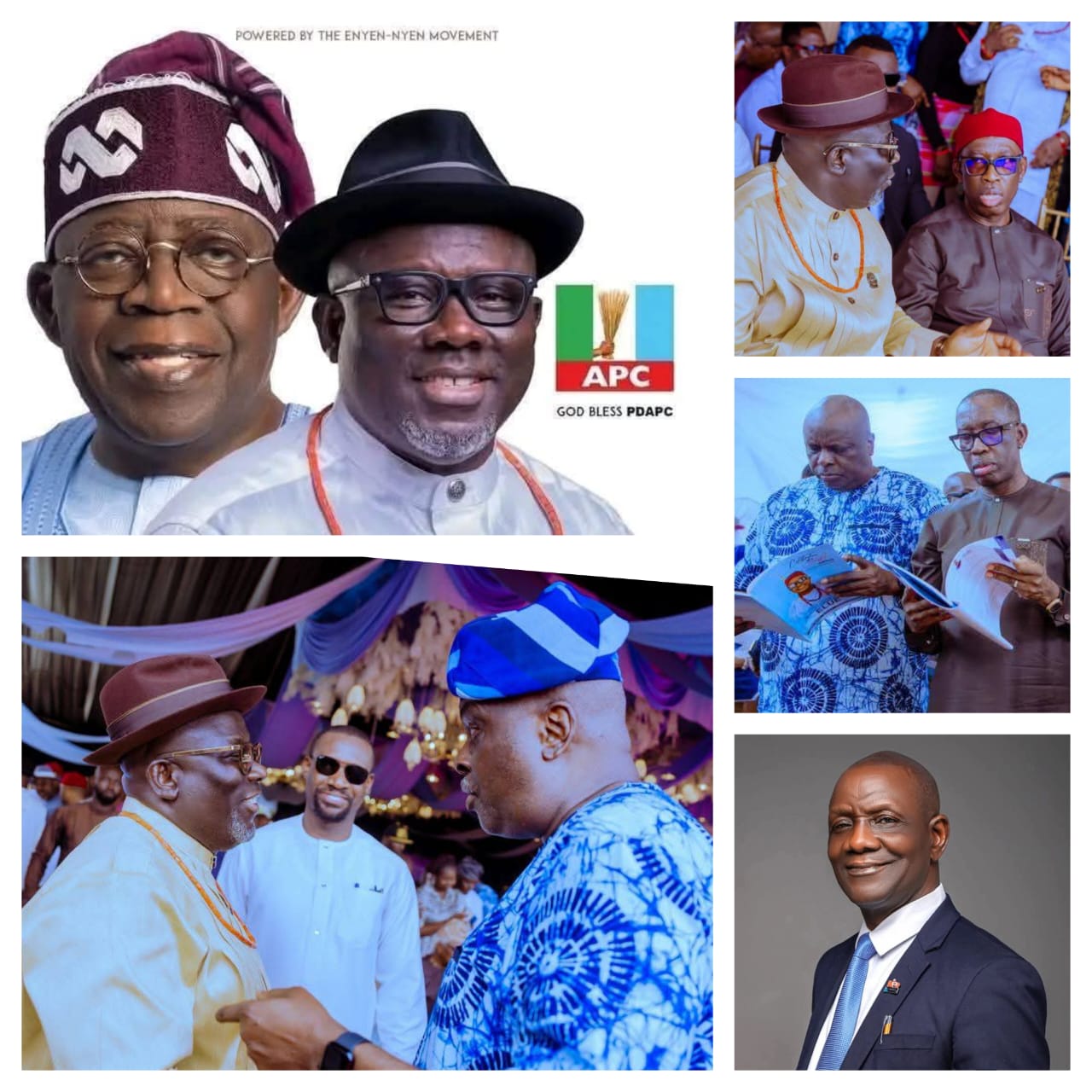
Delta’s Power Triangle: Oborevwori, Ibori, Okowa and the 2027 Sweep
By Fred Latimore Oghenesivbe Esq
The reconciliation between Governor Sheriff Oborevwori and former governor James Ibori has already been interpreted as a turning point in Delta’s political evolution. But to fully grasp its significance, one must bring a third force into the equation: Senator Ifeanyi Arthur Okowa, the immediate past governor of Delta State.
Both Governor Oborevwori and Densto Okowa are, in many respects, products of the Ibori era (1999–2007), a period that laid the institutional and structural foundations of modern Delta politics. That shared history is now translating into a renewed alignment of interests, experience, and networks. What is emerging is not just unity, but a layered synergy that spans political generations and consolidates influence across the state’s key blocs.
Okowa’s role in this triangle is particularly pivotal. As the immediate past governor who backed Oborevwori to victory in 2023, he remains a bridge between continuity and transition. His political machinery, combined with his technocratic reputation, complements Ibori’s grassroots reach and Oborevwori’s incumbency. Together, they form a three-tier structure: legacy, strategy, and execution.
With Okowa’s recent appointment as South-South Coordinator of the Renewed Hope Ambassadors, the mobilization platform aligned with Bola Tinubu, the Delta triangle is no longer operating in isolation. It is intersecting directly with the political interests of the All Progressives Congress (APC) at the highest level.
This development carries strategic weight. Delta State now presents a different outlook. The convergence of Ibori’s enduring grassroots network, Okowa’s organizational depth, and Oborevwori’s control of state structures creates a formidable electoral machine, one that could significantly alter voting patterns in 2027.
For President Tinubu, this is more than a regional gain; it is a strategic breakthrough. Electoral victories in Nigeria are built on coalitions, and the ability to penetrate previously resistant states often determines the margin between victory and vulnerability. A coordinated Delta front, anchored by these three figures, increases the robust chances of a decisive showing in the South-South for President Bola Tinubu in 2027
At the state level, the implications are equally profound. A sitting governor backed by both his predecessor and the state’s most influential political patriarch is positioned not just to compete, but to dominate. The prospect of a fragmented opposition facing such a unified bloc suggests that the path to 2027 is already tilting in President Tinubu and Governor Oborevwori’s favour.
There is also a forward-looking dimension to Okowa’s involvement. Rumours of his potential return to the Senate, where he previously represented Delta North from 2011 to 2015, add another layer to this evolving strategy. Such a move would extend the triangle’s influence beyond the executive arm into the legislative sphere, ensuring that Delta’s voice is amplified both in governance and lawmaking.
Even so, the direction of travel is unmistakable. The Ibori–Oborevwori reconciliation, reinforced by Okowa’s strategic positioning, is reshaping Delta’s political landscape into a more cohesive and influential bloc. It is a recalibration that strengthens the state’s leverage in national affairs while simultaneously enhancing the electoral prospects of both Governor Oborevwori and President Tinubu.
If sustained, this triad could well define Delta politics for the next electoral cycle, turning what was once a fragmented arena into a coordinated force with both state and national reach.
***
The Writer: Fred Latimore Oghenesivbe Esq, is the Director General of Delta State Bureau for Orientation and Communications, Governor’s Office Asaba.