
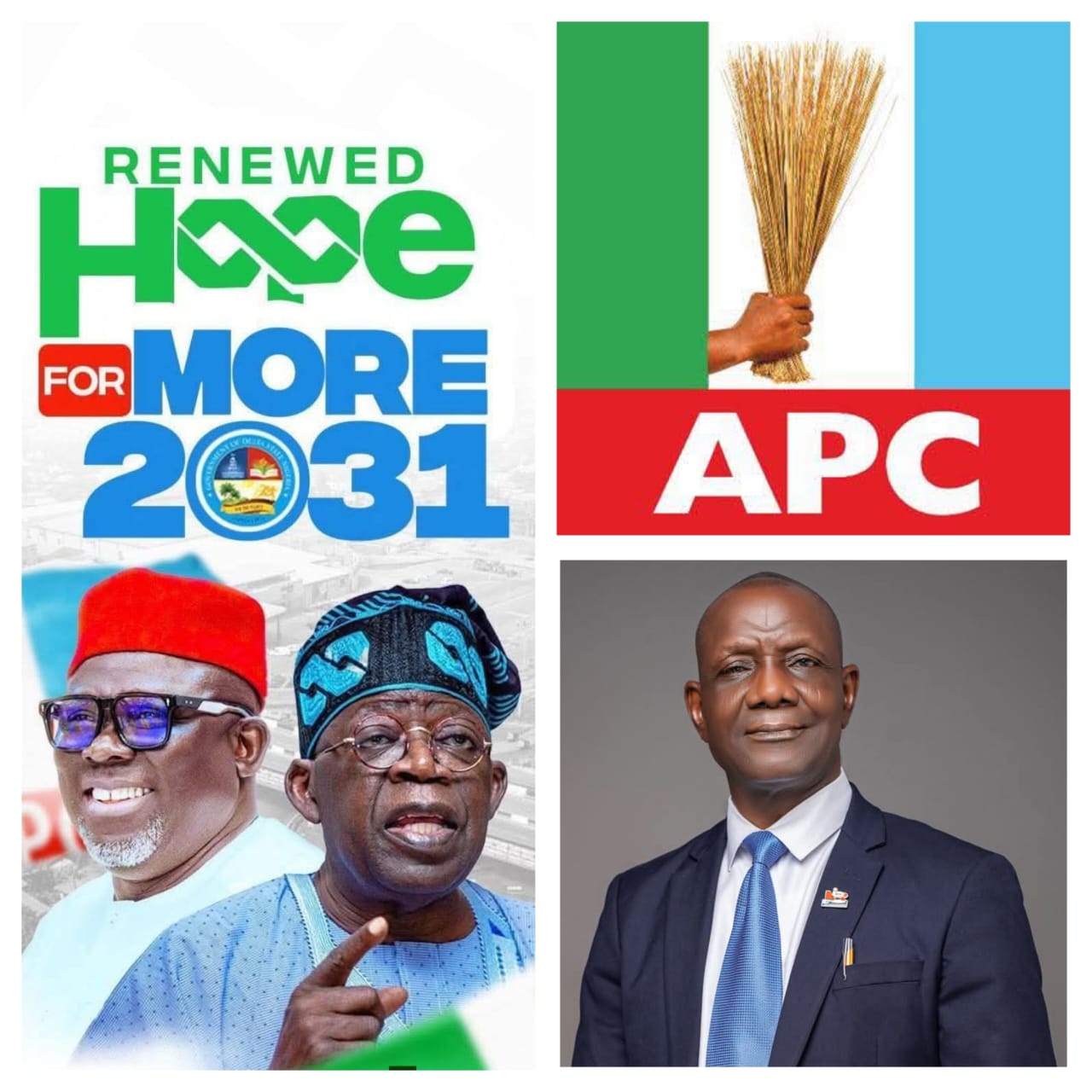
Delta 2027: Oborevwori Holds the Ace as Opposition Stays in the Shadows
By Fred Latimore Oghenesivbe
As the battle for 2027 gradually takes shape, one political reality is becoming unmistakably clear in Delta State: Governor Sheriff Oborevwori has emerged as the man to beat, while the opposition remains fragmented, uncertain, and largely invisible
With the governor already screened and cleared by the All Progressives Congress for re-election, the political momentum appears firmly on his side. Across the state, the conversation is no longer about whether Oborevwori will be a major contender in 2027, but whether any opposition platform possesses the structure, cohesion, grassroots reach, and political firepower to challenge him effectively.
At the moment, the opposition landscape in Delta State appears weakened by internal disputes, organisational instability, and declining cohesion. The Peoples Democratic Party (PDP) is still entangled in unresolved congress-related disputes and leadership tensions. The Labour Party (LP) has struggled to retain its earlier momentum following national political realignments, while the African Democratic Congress (ADC), has been fragmented by the exit of Peter Obi and Kwankwaso, while several emerging platforms like Nigeria Democratic Congress (NDC) are yet to demonstrate nationwide and state structures required for a competitive governorship race.
With INEC deadlines for party primaries and candidate submissions fast approaching, political parties are increasingly constrained not just by internal politics but by procedural compliance realities that leave little room for late recovery. In that context, no clearly formidable governorship challenger has emerged in Delta State.
That vacuum has strengthened the perception that Governor Oborevwori currently holds a commanding strategic advantage ahead of the election. Political observers insist that his advantage is not rooted in incumbency alone, but in governance performance, fiscal discipline, expanding infrastructure, and a carefully managed alignment with the Renewed Hope economic direction of President Bola Ahmed Tinubu.
Since assuming office in May 2023, Governor Oborevwori has pursued the MORE Agenda; Meaningful Development, Opportunities for All, Realistic Reforms, and Enhanced Peace and Security which remains the core governance framework of his administration.
That agenda has increasingly found convergence with President Tinubu’s Renewed Hope vision, producing what APC stakeholders now echoes as the “Renewed Hope for MORE Agenda,” reflecting a growing policy and political alignment between Abuja and Asaba
Supporters argue that this convergence is reinforced by federal fiscal reforms, particularly the removal of fuel subsidy, which significantly increased monthly allocations to states and expanded subnational fiscal capacity.
While implementation remains politically sensitive, the policy has altered the financial structure of governance nationwide, giving state governments greater room for infrastructure development, debt servicing, and social investment.
In Delta State, Governor Oborevwori has been widely credited with deploying these resources into visible development outcomes across sectors. From Delta Central to Delta South, further to Delta North, and across riverine communities, the administration has intensified road construction, urban renewal, and infrastructure rehabilitation aimed at improving connectivity and stimulating economic activity.
The ongoing transformation of Highways -Rural-Urban corridor through major road and flyover projects has become one of the defining infrastructure achievements of the administration. Beyond infrastructure, the government has maintained a reputation for fiscal discipline, including steady debt repayment efforts while sustaining capital projects and government services.
Economic observers continue to point to Delta State’s improved fiscal stability as evidence of structured financial management. In education, the administration has sustained bursary and scholarship schemes, upgraded infrastructure, expanded technical and vocational training, and strengthened learning support systems across the state.
Healthcare delivery has also witnessed rehabilitation of facilities, expansion of primary healthcare services, and interventions aimed at improving access to medical care in underserved communities. Agricultural programmes have focused on youth participation, food security initiatives, and economic diversification away from oil dependence.
A defining feature of the administration remains its inclusive governance style. Across Delta’s diverse ethnic and political composition, Governor Oborevwori has maintained a consultative and bridge-building approach, reinforcing political stability and broad-based acceptance
Across communities, markets, youth groups, and political gatherings, one refrain continues to gain traction: “Oborevwori Again 2027.” For supporters, it reflects continuity, stability, and sustained development momentum.
At the national level, supporters of President Tinubu project similar confidence ahead of 2027, citing ongoing economic reforms, fiscal restructuring, and infrastructure investments as factors strengthening the All Progressives Congress.
Within Delta State, the growing political and developmental convergence between the Renewed Hope Agenda and the MORE Agenda has created a unified narrative linking federal reform direction with state-level execution.
Increasingly, political alignments within the state appear to be consolidating around the incumbent, further narrowing the competitive space. While elections remain inherently dynamic and subject to last-minute political adjustments, the current configuration in Delta State presents an arithmetic that strongly favours continuity.
At this stage, Governor Sheriff Oborevwori, backed by governance performance and a strengthening political structure, appears firmly positioned at the centre of Delta State’s evolving electoral equation, and in the calculations of many observers, he holds the ace.
***
Fred Latimore Oghenesivbe, Esq is the Director General, Delta State Bureau for Orientation and Communications, Governor’s Office Asaba.