
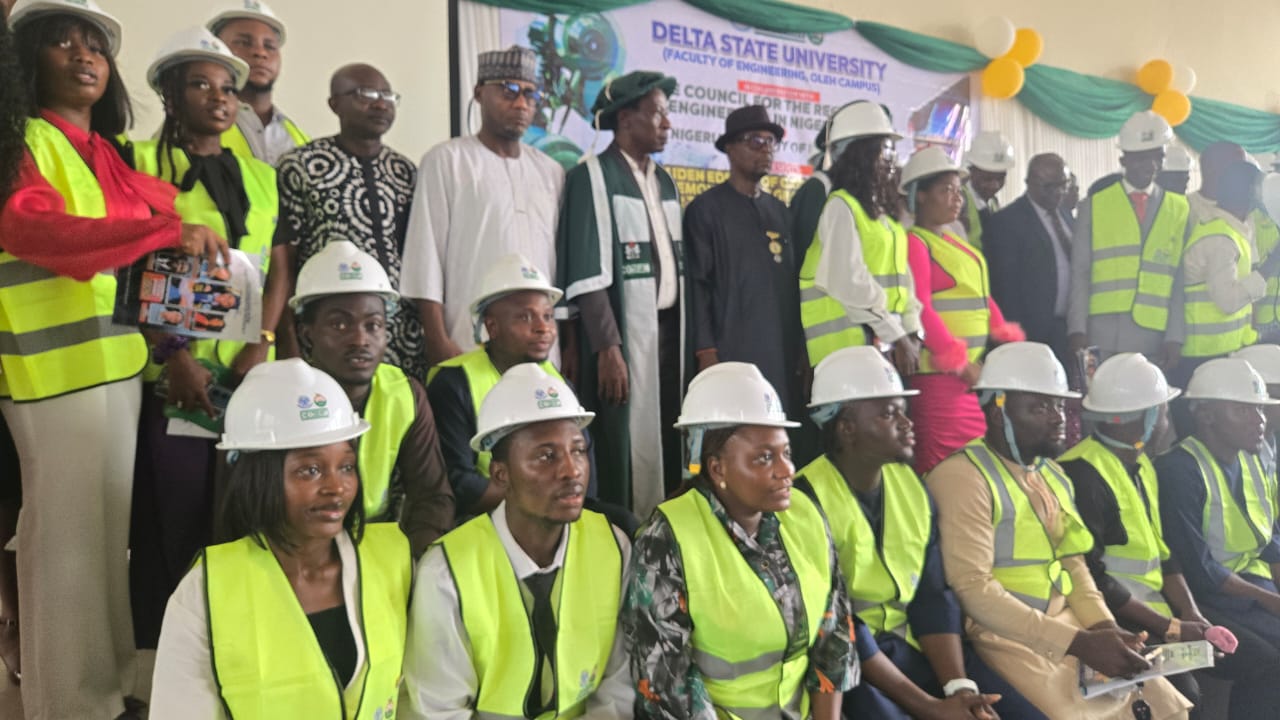
The Delta State University, Oleh Campus, has inducted 282 graduate engineers into the engineering profession in collaboration with the Council for the Regulation of Engineering in Nigeria (COREN) and the Nigerian Society of Engineers (NSE).
The maiden oath-taking and induction ceremony, organised for the 2024/2025 academic session, was held at the Faculty of Engineering, Oleh Campus, in Isoko South Local Government Area of Delta State.
The event marked a significant milestone in the professional development of the graduates, who were charged to uphold the ethics, standards and responsibilities of the engineering profession.
Representing the Vice-Chancellor, Prof. Samuel Asagba, the Deputy Vice-Chancellor (Academic), Engr. Prof. Hilary Owamah, reaffirmed the university management’s commitment to repositioning the Faculty of Engineering and improving academic activities.
Owamah said the Vice-Chancellor had prioritised the development of the faculty and was determined to provide the necessary facilities and equipment to enhance teaching, learning and practical training.
He assured that the university would continue to support the faculty in delivering quality engineering education and preparing graduates for the demands of the profession.
In his remarks, the Dean of the Faculty of Engineering, Oleh Campus, Engr. Prof. K.M. Oghenejoboh, urged the newly inducted engineers to uphold integrity, competence, honesty, discipline and accountability in their professional conduct.
He described the induction as an important stage in their careers, noting that engineering remained a critical profession in national development.
Oghenejoboh also highlighted opportunities available to Nigerian engineering graduates through the country’s membership of the Washington Accord, which provides a framework for recognising qualifications from accredited engineering programmes across member countries, including the United States, Canada, the United Kingdom and Germany.
He encouraged the graduates to apply their knowledge and skills to addressing national challenges, particularly in infrastructure development, sustainable energy, transportation, manufacturing, digital transformation and environmental protection.
Speaking on behalf of the President of COREN, Engr. Prof. Sadiq Zubair Abubakar, the Chairman of the Delta State Technical Committee on Engineering Regulations Monitoring, Engr. Solomon A. Aghagba, called on universities offering engineering programmes to maintain high academic standards and equip graduates with globally competitive skills.
Aghagba, who is also the Permanent Secretary, Delta State Ministry of Works, disclosed that approximately 123 universities in Nigeria offer engineering education through more than 622 programmes.
He said the country’s available educational resources, if properly harnessed, could support the production of at least 15,000 engineering graduates across different disciplines.
According to him, COREN has developed a checklist based on international best practices to guide engineering education and ensure that students meet the required academic and professional standards.
He reaffirmed the council’s commitment to supporting DELSU in meeting the benchmarks of the Washington Accord through training, capacity development, accreditation and other quality assurance initiatives.
Aghagba emphasised the importance of collaboration among regulatory bodies, professional associations and universities in bridging the gap between classroom instruction and industry expectations.
He said such partnerships would ensure that engineering graduates acquire the practical knowledge, competence and proficiency required to function effectively in the workplace.
He commended DELSU for its contributions to academic development and congratulated the inductees, urging them to remain committed to the ethical demands of their profession.
Also speaking, Engr. Goodluck Ohwodo, who represented the President of the Nigerian Society of Engineers, Engr. Ali Alimasuya Rabiu, expressed satisfaction with the successful induction of the 282 graduates.
He advised the inductees to complete their registration with COREN, explaining that professional registration was essential to their career development and eventual practice as registered engineers.
Ohwodo reminded the graduates that engineering was governed by established ethical standards and regulations, which they must understand and observe throughout their careers.
He further urged them to serve as worthy ambassadors of the profession through diligence, integrity and professionalism, stressing the importance of maintaining public confidence in engineering practice.
Delivering the keynote lecture titled “Ethical Issues and the Prospects of Young Engineers in an AI Generation,” Owamah cautioned the graduates against excessive dependence on artificial intelligence in their academic and professional activities.
He acknowledged that AI could simplify tasks and provide useful information but stressed that it could not replace professional judgement, integrity and personal responsibility.
The Deputy Vice-Chancellor also challenged the inductees to maximise the opportunities provided by the National Youth Service Corps (NYSC) programme by seeking placements where they could apply their engineering knowledge and gain practical experience.
He encouraged them to be confident in their abilities and avoid limiting their service experience to classroom teaching when opportunities existed to participate in engineering-related assignments.
Owamah stressed that the future of engineering would depend not only on technical expertise but also on the character, ethical values and practical competence of the next generation of professionals.